
Время чтения: 16 мин.
Заболела раз у одного богача жена и почувствовала, что конец ей приходит. Подозвала она свою единственную дочку к постели и говорит:
— Мое милое дитя, будь скромной и ласковой, и господь тебе всегда поможет, а я буду глядеть на тебя с неба и всегда буду возле тебя.
Потом закрыла она глаза и умерла. Девочка ходила каждый день на могилу к матери и плакала, и была смирной и ласковой.
Вот наступила зима, и снег укутал белым саваном могилу, а когда весной опять засияло солнышко, взял богач себе в жены другую жену.
Привела мачеха в дом своих дочерей. Были они лицом красивые и белые, но сердцем злые и жестокие. И настало тогда тяжелое время для бедной падчерицы.
— Неужто эта дура будет сидеть у нас в комнате? — сказала мачеха. — Кто хочет есть хлеб, пускай его заработает. А ну-ка, живей на кухню, будешь стряпухой.
Отобрали они у нее красивые платья, надели на нее старую посконную рубаху и дали ей деревянные башмаки.
— Поглядите-ка на эту гордую принцессу, ишь как вырядилась, — говорили они, смеясь, и отвели ее на кухню.
И должна она была там с утра до самого позднего вечера исполнять черную работу: вставать рано утром, носить воду, топить печь, стряпать и мыть. А кроме того, сводные сестры всячески старались, как бы ее посильней огорчить — насмехались над нею, высыпали горох и чечевицу в золу, и ей приходилось сидеть и выбирать их оттуда опять.
Вечером, когда она от работы уставала, ей приходилось ложиться спать не в постель, а на полу, рядом с печкой, на золе. И оттого, что была она всегда в золе, в пыли и грязная, прозвали ее сестры Золушкой.
Случилось однажды, что отец собрался ехать на ярмарку, и спросил у своих падчериц, что привезти им в подарок.
— Красивые платья, — сказала одна.
— Жемчуга и драгоценные камни, — попросила другая.
— Ну, а ты что, Золушка, хочешь?
— Привези мне, батюшка, ветку, что на обратном пути первая зацепит тебя за шапку, — отломи ее и привези мне с собой.
Накупил отец своим падчерицам красивые платья, жемчуга и самоцветные камни, и когда на обратном пути ехал он через лесок, ветка орешника хлестнула его, да так сильно, что и шапку с головы у него сбила, он сорвал эту ветку и привез ее с собой. Воротился он домой и подарил падчерицам то, что они просили, а Золушке отдал ветку орешника.
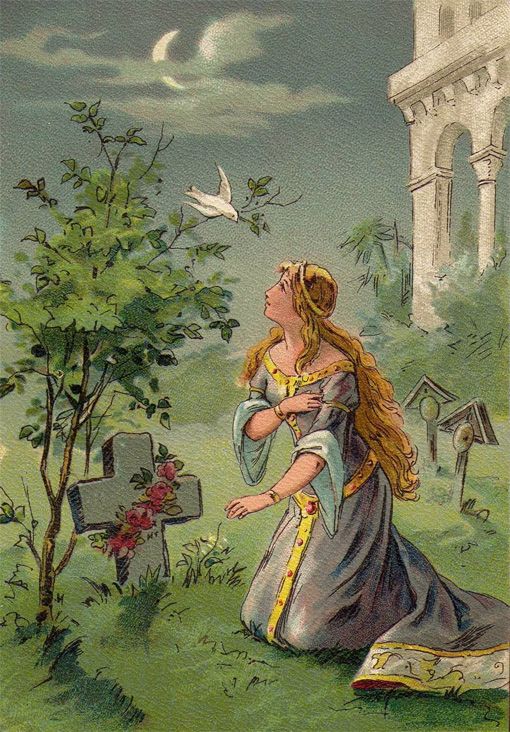
Поблагодарила его Золушка, пошла на могилу к матери и посадила там ветку и так сильно плакала, что слезы катились у нее из глаз на землю, и они полили ту ветку. Вот выросла веточка и стала красивым деревом. Золушка трижды в день приходила к дереву, плакала и молилась; и каждый раз прилетала на дерево белая птичка; и когда Золушка ей говорила какое-нибудь желание, птичка сбрасывала ей то, что она просила.
Но вот случилось однажды, что король затеял пир, который должен был длиться целых три дня, и созвал на праздник всех красивых девушек страны, с тем чтобы сын его мог выбрать себе невесту. Когда две названые сестры узнали о том, что им тоже надо явиться на пир, они стали добрые, кликнули Золушку и говорят:
— Причеши нам волосы, почисть туфли и застегни застежки, да покрепче, мы ведь идем в королевский дворец на смотрины.
Золушка их послушалась, но заплакала — ей тоже хотелось пойти потанцевать; она стала просить мачеху, чтобы та отпустила ее.
— Ты ведь Золушка, — сказала ей мачеха, — вся ты в золе да в грязи, куда уж тебе идти на пир? У тебя ведь ни платья нету, ни туфель, а ты хочешь еще танцевать.
Перестала Золушка ее просить, а мачеха ей и говорит:
— Вот просыпала я миску чечевицы в золу. Коль выберешь ее за два часа, тогда можешь идти вместе с сестрами.
Вышла Золушка черным ходом в сад и молвила так:
— Вы, голубки ручные, вы, горлинки, птички поднебесные, летите, помогите мне выбрать чечевицу!
Хорошие — в горшочек,
Поплоше, те в зобочек.
И прилетели к кухонному окошку два белых голубка, а за ними и горлинка, и наконец прилетели-послетались все птички поднебесные и опустились на золу. Наклонили голубки свои головки и начали клевать: тук-тук-тук-тук, а за ними и остальные тоже: тук-тук-тук-тук, и так повыбрали все зернышки в мисочку. Не прошло и часу, как кончили они работу и все улетели назад.
Принесла Золушка мисочку своей мачехе, стала радоваться, думая, что ей можно будет идти на пир, но мачеха сказала:
— Нет, Золушка, ведь у тебя нет платья, да и танцевать ты не умеешь, — там над тобой только посмеются.
Заплакала Золушка, а мачеха и говорит:
— Вот если выберешь мне за один час из золы две полных миски чечевицы, то можешь пойти вместе с сестрами, — а сама подумала про себя: «Этого уж ей не сделать никогда». Высыпала мачеха две миски чечевицы в золу, а девушка вышла через черный ход в сад и молвила так:
— Вы, голубки ручные, вы, горлинки, птички поднебесные, летите, помогите мне выбрать чечевицу!
Хорошие — в горшочек,
Поплоше, те в зобочек.
И прилетели к кухонному окошку два белых голубка, а вслед за ними и горлинка, и наконец прилетели-послетались все птички поднебесные и спустились на золу. Наклонили голубки головки и начали клевать: тук-тук-тук-тук, а за ними и остальные тоже: тук-тук-тук-тук, и повыбрали все зернышки в миску. Не прошло и получаса, как кончили они работу и улетели все назад.
Принесла Золушка две миски чечевицы мачехе, стала радоваться, думая, что теперь-то ей можно будет идти на пир, а мачеха и говорит:
— Ничего тебе не поможет: не пойдешь ты вместе со своими сестрами, — и платья у тебя нету да и танцевать ты не умеешь, — нам будет за тебя только стыдно.
Повернулась она спиной к Золушке и поспешила со своими двумя дочерьми на пир.
Когда дома никого не осталось, пошла Золушка на могилу к своей матери под ореховое деревцо и кликнула:
Ты качнися-отряхнися, деревцо,
Кинься златом-серебром ты мне в лицо.
И сбросила ей птица золотое и серебряное платье, шитые шелком да серебром туфельки. Надела она быстро это платье и явилась на смотрины.
А сводные ее сестры и мачеха об этом не знали и подумали, что это, должно быть, какая-то чужая королевна, — такая красивая была она в своем золотом платье. Им и в голову не приходило, что это Золушка; они думали, что сидит она дома в грязи и выбирает из золы чечевицу.
Вот вышел ей навстречу королевич, взял ее за руку и стал с ней танцевать. И не хотел он танцевать ни с какой другой девушкой, всё держал ее за руку, и если кто подходил приглашать ее на танец, он говорил:
— Я с ней танцую.
Проплясала она до самого вечера и хотела уже домой возвращаться, а королевич ей и говорит:
— Я пойду тебя проводить. — Ему хотелось узнать, чья это дочка-красавица; но она от него убежала и взобралась на голубятню.
И дождался королевич до тех пор, пока не пришел отец, и сказал ему королевич, что какая-то неизвестная девушка взобралась на голубятню. Старик подумал: «А не Золушка ли это?» и велел принести топор и багор, чтобы разрушить голубятню, но в ней никого не оказалось.
Вернулись родители домой, видят — лежит Золушка в своей посконной рубахе на золе, и горит у печки тусклая масляная лампочка. А дело было так: Золушка быстро выпрыгнула с другой стороны голубятни и побежала к ореховому деревцу, там она сняла свое красивое платье и положила его на могилу; унесла его птица назад, и надела Золушка опять свою серую посконную рубаху и села в кухне на кучу золы.
На другой день, когда пир начался снова и родители и сводные сестры ушли опять из дому, направилась Золушка к ореховому дереву и молвила так:
Ты качнися-отряхнися, деревцо,
Кинься златом-серебром ты мне в лицо.
И сбросила ей птица еще более пышное платье, чем в прошлый раз. И когда явилась она в этом платье на пир, каждый дивился, глядя на ее красоту. Королевич ждал ее, пока она не пришла, и тотчас взял ее за руку и танцевал только с нею одной. Когда к ней подходили другие и приглашали ее на танец, он говорил:
— Я с ней танцую.
Вот наступил вечер, и она собралась уходить, и пошел королевич следом за ней, чтобы посмотреть, в какой дом она войдет. Но она убежала прямо в сад, который находился за домом. И росло в том саду красивое большое дерево, и висели на нем чудесные груши. Она проворно взобралась на него, как белочка по веткам, а королевич и не заметил, куда она исчезла. Стал он ее поджидать, и когда явился отец, королевич ему говорит:
— От меня убежала неизвестная девушка, мне кажется, что она взобралась на грушу.
Отец подумал: «Уж не Золушка ли это?», и велел принести топор и срубил дерево, но на нем никого не оказалось. Пришли они в кухню, видят — лежит Золушка, как и в прошлый раз, на золе; как и тогда, она спрыгнула с другой стороны дерева и отдала птице, что прилетела на ореховое дерево, свое прекрасное платье и надела опять серую посконную рубаху.
На третий день, когда родители и сводные сестры ушли на пир, отправилась Золушка снова на могилу к матери и молвила деревцу:
Ты качнися-отряхнися, деревцо,
Кинься златом-серебром ты мне в лицо.
И сбросила ей птица платье, такое сияющее и великолепное, какого еще никогда ни у кого не было; а туфельки были из чистого золота.
Вот явилась она на пир в этом платье, и никто не знал, что и сказать от изумленья. Королевич танцевал только с нею одной, а если кто ее приглашал, он говорил:
— Я с ней танцую.
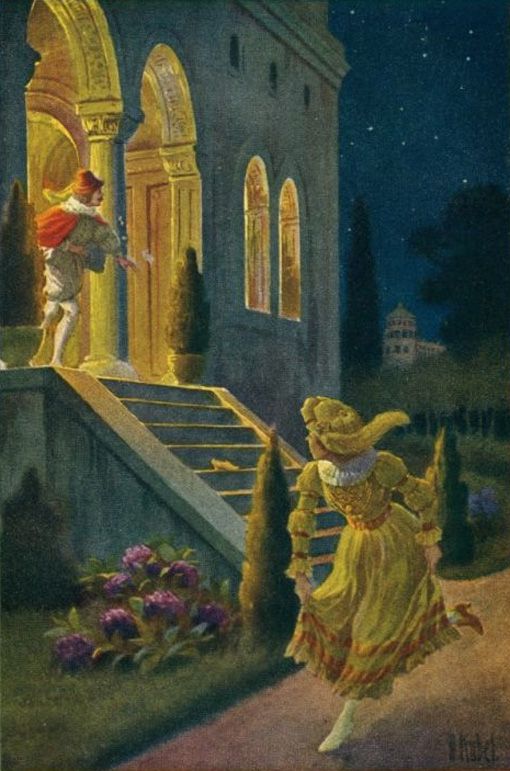
Вот наступил вечер, и собралась Золушка уходить; и хотелось королевичу ее проводить, но она так ловко от него ускользнула, что он даже этого и не заметил. Но придумал королевич хитрость: он велел вымазать всю лестницу смолой; и когда она от него убегала, то туфелька с ее левой ноги осталась на одной из ступенек. Королевич поднял эту туфельку, и была она такая маленькая и нарядная и вся из чистого золота.
На другое утро пошел королевич с той туфелькой к отцу Золушки и говорит:
— Моей женой будет только та, на чью ногу придется эта золотая туфелька.
Обрадовались обе сестры — ноги у них были очень красивые. Старшая отправилась в комнату, чтобы примерить туфельку, и мать была тоже с нею. Но никак не могла она натянуть туфельку на ногу: мешал большой палец, и туфелька оказалась ей мала. Тогда мать подала ей нож и говорит:
— А ты отруби большой палец; когда станешь королевой, все равно пешком ходить тебе не придется.
Отрубила девушка палец, натянула с трудом туфельку, закусила губы от боли и вышла к королевичу. И взял он ее себе в невесты, посадил на коня и уехал с нею.
Но надо было им проезжать мимо могилы, а сидело там два голубка на ореховом деревце, и запели они:
Погляди-ка, посмотри,
А башмак-то весь в крови,
Башмачок, как видно, тесный,
Дома ждет тебя невеста.
Посмотрел королевич на ее ногу, видит — кровь из нее течет. Повернул он назад коня, привез самозванную невесту домой и сказал, что это невеста не настоящая, — пускай, мол, наденет туфельку другая сестра.
Пошла та в комнату, стала примерять, влезли пальцы в туфельку, а пятка оказалась слишком большая. Тогда мать подала ей нож и говорит:
— А ты отруби кусок пятки: когда будешь королевой, пешком тебе все равно ходить не придется.
Отрубила девушка кусок пятки, всунула с трудом ногу в туфельку, закусила губы от боли и вышла к королевичу. И взял он ее себе в невесты, посадил на коня и уехал с ней.
Но проезжали они мимо орехового деревца, а сидело на нем два голубка, и они запели:
Погляди-ка, посмотри,
А башмак-то весь в крови,
Башмачок, как видно, тесный,
Дома ждет тебя невеста.
Глянул он на ее ногу, видит — кровь течет из туфельки, и белые чулки совсем красные стали. Повернул он коня и привез самозванную невесту назад в ее дом.
— И эта тоже не настоящая, — сказал он, — нет ли у вас еще дочери?
— Да вот, — сказал отец, — осталась от покойной моей жены маленькая, несмышленая Золушка, — да куда уж ей быть невестой!
Но королевич попросил, чтоб ее привели к нему: а мачеха и говорит:
— Да нет, она такая грязная, ей нельзя никому и на глаза показываться.
Но королевич захотел во что бы то ни стало ее увидеть; и пришлось привести к нему Золушку. И вот умыла она сначала руки и лицо, потом вышла к королевичу, склонилась перед ним, и он подал ей золотую туфельку. Села она на скамейку, сняла с ноги свой тяжелый деревянный башмак и надела туфельку, и пришлась она ей как раз впору. Вот встала она, посмотрел королевич ей в лицо и узнал в ней ту самую красавицу-девушку, с которой он танцевал, и он воскликнул:
— Вот это и есть настоящая моя невеста!
Испугались мачеха и сводные сестры, побледнели от злости; а он взял Золушку, посадил на коня и ускакал с ней.
Когда проезжали они мимо орехового деревца, молвили два белых голубка:
Оглянися, посмотри,
В башмачке-то нет крови,
Башмачок, видать, не тесный,
Вот она — твоя невеста!
Только они это вымолвили, улетели оба с дерева и уселись на плечи к Золушке: один на правое плечо, другой на левое, — так и остались они сидеть.
Когда пришло время быть свадьбе, явились и вероломные сестры, хотели к ней подольститься и разделить с ней ее счастье. И когда свадебный поезд отправился в церковь, сидела старшая по правую руку, а младшая по левую; и вот выклевали голуби каждой из них по глазу. А потом, когда возвращались назад из церкви, сидела старшая по левую руку, а младшая по правую; и выклевали голуби каждой из них еще по глазу.
Так вот были они наказаны за злобу свою и лукавство на всю свою жизнь слепотой.
Время чтения для детей: 21 мин
Случилось как-то, что жена одного богатого человека заболела, и когда она почувствовала, что ее конец близок, то подозвала к своей постели единственную дочку и сказала: „Милое дитя, будь всегда доброю и Бога не забывай, тогда он тебе будет помощник; а я с того света на тебя смотреть стану и всегда духом буду с тобою.“ Затем она закрыла глаза и почила.
Дочка каждый день ходила на могилку матери и постоянно была ко всем добра, и Бога не забывала. Пришла зима, прикрыла могилку снежным пологом, и чуть только снег растаял от весеннего солнца, отец сиротки женился на другой женщине.
Мачеха ввела в дом своих двух дочерей, белолицых и красивых с виду, но злых и бессердечных. Тогда наступила тяжелая година для бедной падчерицы. „Неужели эта дура будет у нас в комнатах сидеть! – заговорили мачехины дочки. – Кто хочет хлеба есть, тот поди-ка заработай его: прочь отсюда, судомойка!“
Они отняли у нее хорошие платья, напялили на нее старое серое платьишко и обули ее в деревянные башмаки. „Гляньте-ка на эту гордячку, как она вырядилась!“ – заговорили они, стали смеяться и отвели бедняжку в кухню.
Там должна она была с утра до вечера нести на себе всю черную работу, вставать рано, до света, воду носить, огонь разводить, стряпать и мыть. Сверх того, названые сестрицы старались всякими способами ее огорчать, осмеивали ее, высыпали в золу горох и чечевицу, приготовленные для кушанья, так что бедная сиротинка должна была выбирать их из золы по зернышку.
Ввечеру, утомившись от работы, она не имела даже кровати, на которую могла бы лечь: она должна была рядом с очагом ложиться в золу и на ней спать. И так как она от золы была постоянно покрыта и пылью, и грязью, то злые сестры и назвали ее Замарашкой.
Случилось однажды, что отец собрался на ярмарку и спросил своих падчериц, чего им оттуда привезти? „Красивые наряды,“ – сказала одна из них. „Жемчуг и драгоценные камни,“ – сказала другая. „Ну, а тебе, Замарашечка, – спросил отец, – тебе что привезти?“ – „Батюшка, привези ту веточку, которая на обратном пути прежде всех хлестнет тебя по шляпе; ту отломи и привези мне!“
Вот и закупил он своим двум падчерицам нарядные платья, жемчуг и драгоценные камни; а на обратном пути, в то время как он пробирался сквозь зеленую чащу кустов, ветка орешника хлестнула его так сильно, что и шапку с него сбила долой. Ту ветку он обломил и прихватил с собою.
Приехав домой, он отдал падчерицам то, что им было любо, а Замарашке – ветку орешника. Замарашка поблагодарила его, пошла на могилку матери, посадила над нею свою веточку и плакала так неутешно, что слезы ее обильно оросили эту ветку. И выросла веточка в целое деревцо.
Замарашка каждый день трижды ходила под это деревцо, плакала там и молилась, и каждый раз прилетала на то дерево и садилась беленькая птичка, и стоило только бедняжке высказать какое-нибудь желание, как уж птичка сейчас его выполняла и сбрасывала ей с деревца то, что она пожелает.
Случилось как-то, что король той страны затеял праздник, и праздник тот должен был продолжаться три дня; на этот праздник он задумал созвать всех красавиц со всего королевства, чтобы его сын мог себе выискать между ними невесту. Обе названые ее сестры, услышав, что и они тоже должны явиться на тот праздник, стали поласковее, призвали Замарашку и сказали: „Расчеши нам волосы, вычисти башмаки и закрепи на них пряжки – мы идем на праздник в королевский замок.“
Замарашка повиновалась им, однако же заплакала, потому что и ей тоже хотелось идти вместе с сестрами и потанцевать; она даже попросила у мачехи, чтобы та ее отпустила на праздник. „Ты, Замарашка, – крикнула мачеха, – вся ты в грязи и в пыли и тоже на праздник собираешься! Нет на тебе ни платьишка, ни башмаков – и туда же танцевать лезешь!“
Когда Замарашка не стала более просить ее, то мачеха сказала ей: „Вот я тебе высыпала в золу полное блюдо чечевицы, и если ты через два часа сумеешь эту чечевицу из золы повыбрать, тогда, пожалуй, ступай вместе с сестрами на праздник!“
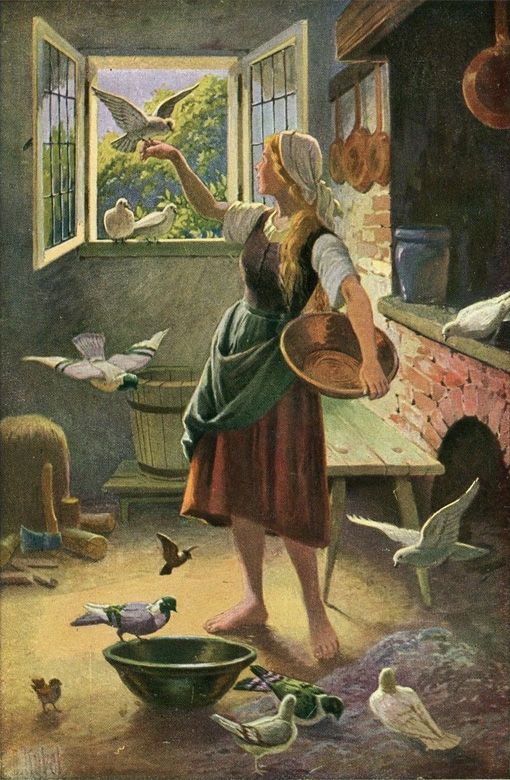 образ: Otto Kubel (1868 – 1951)
Бедная сиротка сошла по черной лестнице в сад и крикнула во весь голос: „Голубки-голубочки, милые дружочки, и вы все, пташечки поднебесные, слетайтесь сюда, помогите мне, бедной, собрать чечевички:
Те, что годны, в горшочек,
А негодны – в зобочек.“
И слетелись на зов ее к окошку кухни сначала два белых голубка, а потом турманы мохноногие, а затем и целые стаи всяких пташечек поднебесных и опустились на золу. И стали голубки кивать головками и начали клевать: пик, пик, пик, пик; и другие тоже: пик, пик, пик, пик – и собрали все годные зерна в блюдо. И часу не прошло, как у них все было готово, и они улетели опять в то же окошко.
Принесла Замарашка блюдо к мачехе с радостью и думала, что вот и ей будет дозволено отправиться с сестрами на праздник.
Но мачеха сказала ей: „Нет, Замарашка, у тебя и платьев не припасено, и танцевать ты не можешь, над тобой только смеяться станут.“ Когда бедняжка стала плакать, мачеха сказала: „Вот если ты мне два блюда чечевицы в час времени из золы выберешь дочиста, тогда, пожалуй, пойдешь.“ А сама думала: „Где же ей это сделать?“
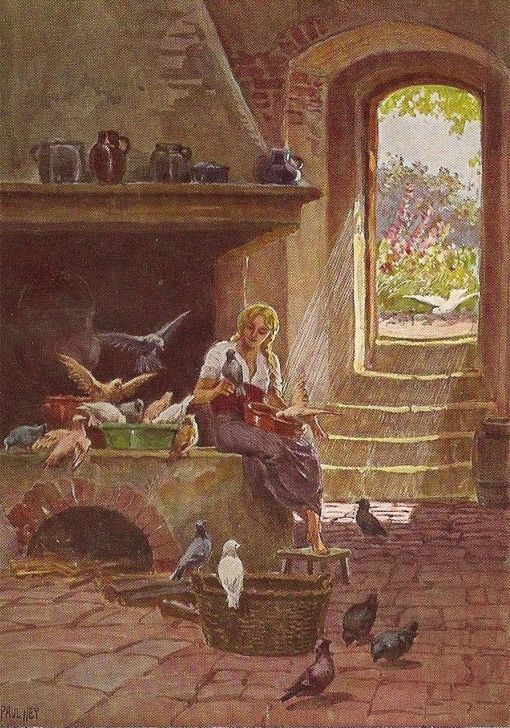 образ: Paul Hey (1867 – 1952)
Но когда она высыпала ей два блюда чечевицы в золу, девушка вышла черным крыльцом в сад и крикнула: „Голубки-голубочки, милые дружочки, и вы все, пташки поднебесные, слетайтесь сюда, помогите мне, бедной, собрать чечевички:
Те, что годны, в горшочек,
А негодны – в зобочек.“
И слетелись на зов ее к окошку кухни сначала два белых голубка, а потом турманы мохноногие, а затем и целые стаи всяких пташек поднебесных и опустились на золу. И стали голубки кивать головками и поклевывать: пик, пик, пик, пик; и другие тоже: пик, пик, пик, пик – и собрали все годные зерна в два блюда. И получаса не прошло, как у них все уже было готово, и все они опять улетели в окошко.
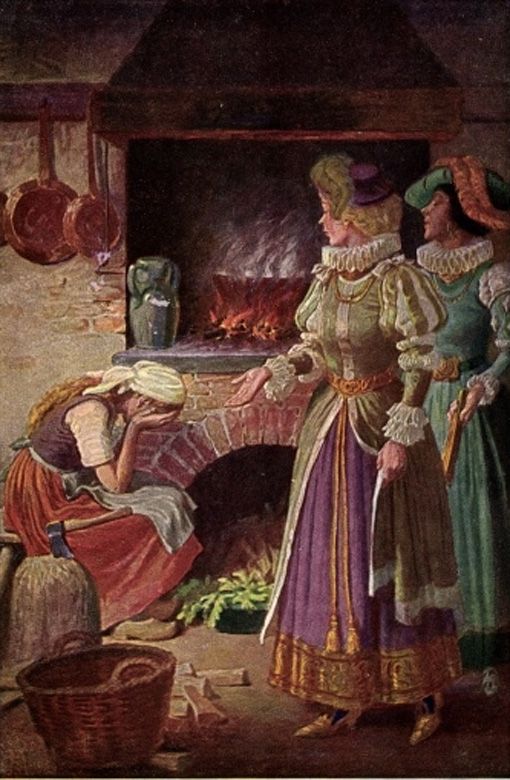 образ: Otto Kubel (1868 – 1951)
Понесла бедняжка оба блюда к мачехе и радовалась, что вот ей будет дозволено отправиться на праздник с сестрами. Но мачеха сказала ей: „Напрасно ты стараешься: ты не пойдешь с нами; у тебя и нарядов нет, и танцевать ты не умеешь; нам бы пришлось краснеть за тебя.“
Повернулась к бедняжке спиной и поспешно удалилась со своими двумя горделивыми дочками.
Оставшись одна-одинешенька в доме. Замарашка пошла на могилу матери под ореховое деревцо и воскликнула:
Встряхнись, встрепенись ты, мое деревцо,
Просыпь на меня злато-серебрецо.
Тогда птичка кинула ей серебряное платье с золотом и туфельки, расшитые шелками и серебром.
Девушка поскорее оделась и поспешила на праздник. А названые сестры ее и мачеха, ничего об этом не зная, подумали, что это какая-нибудь чужая королевна – такой красавицей была она в своем платье, разукрашенном золотом. Замарашка им и в голову не пришла: они думали, что она сидит себе дома да выбирает чечевички из золы.
Сам королевич вышел красавице навстречу, взял ее за руку и все с ней танцевал. Да так и не захотел ни с кем больше танцевать, и руки ее из своей руки не выпустил, и когда подходил к ней кто-нибудь из мужчин, королевич говорил: „Я сам с ней хочу танцевать.“
Так и проплясала она до самого вечера. А когда захотела домой вернуться, то королевич сказал ей: „Я пойду с тобою и провожу тебя.“ Ему смерть как хотелось посмотреть, чья она дочь и из какого дома родом. Но она от него ускользнула и взобралась на голубятню.
Обождал немного королевич, видит, отец Замарашки идет, и говорит ему: „Вот туда на голубятню взобралась одна красавица!“ Отец подумал: „Уж не Замарашка ли?“ – потребовал топор да багор и надвое рассек голубятню, а в ней никого не оказалось. А когда они домой вернулись, Замарашка по-прежнему лежала в своем грязном платьишке на золе, а около нее на трубе тускло горела маленькая масляная лампа.
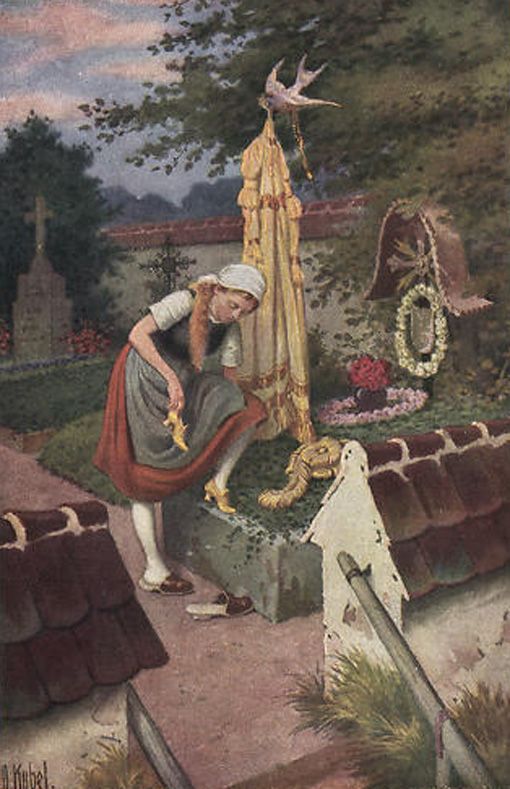 образ: Otto Kubel (1868 – 1951)
Замарашка была проворна: она с одной стороны взобралась на голубятню, а с другой спустилась и мигом под орешиной очутилась; там скинула она свой богатый наряд, положила его на могилку, и птичка снова унесла этот наряд, а сама Замарашка опять напялила на себя серые лохмотья и села в кухне на кучу золы.
На другой день, когда праздник начался снова, и родители с назваными сестрицами опять ушли из дома, Замарашка пошла к орешине и сказала:
Встряхнись, встрепенись ты, мое деревцо,
Просыпь на меня злато-серебрецо.
И птичка сбросила ей платье, еще богаче, еще наряднее вчерашнего. И когда она в этом наряде явилась на празднество, все надивиться не могли ее красоте.
А королевич уж поджидал ее, взял ее тотчас за руку и танцевал только с ней одной. Когда другие мужчины подходили к ней, чтобы пригласить ее на танец, королевич говорил: „Я с ней танцую.“
По наступлении вечера Замарашка надумала удалиться, а королевич пошел за нею следом и хотел посмотреть, в какой дом она войдет; но та юркнула в сторону и убежала в сад позади дома. В том саду росло прекрасное большое грушевое дерево, и на нем много было чудных груш; на него-то и взобралась Замарашка, словно белочка, и укрылась в ветвях его; а королевич даже и не знал, куда она подевалась.
Подождал он немного, пока подошел отец Замарашки, и сказал ему: „Вот тут одна красавица от меня ускользнула, и мне сдается, что она залезла на эту грушу.“
Отец подумал: „Уж не Замарашка ли это?“
 образ: Thekla Brauer (1856 – 1943)
потребовал топор и срубил дерево; но на дереве никого не оказалось. И когда они все вернулись домой, увидели Замарашку, как и всегда, на ее куче золы.
Она проворна была: с одной стороны на дерево влезла, с другой стороны спрыгнула, вернула свой наряд птичке, что сидела на орешине, и опять напялила свои старые лохмотья.
На третий день, когда родители и названые сестры ушли из дома, Замарашка опять пошла на могилку матери и сказала деревцу:
Встряхнись, встрепенись ты, мое деревцо,
Просыпь на меня злато-серебрецо.
Тут птичка сбросила ей платье такое великолепное и так ослепительно блиставшее, что такого еще никто не видал; а к этому платью и туфли чистого золота.
Когда она явилась на празднество в этом наряде, все ей дивились, как чуду.
Королевич только с ней и танцевал, а если подходил к ней кто-нибудь другой, он говорил: „Я с ней танцую.“
 образ: Otto Kubel (1868 – 1951)
Когда наступил вечер, Замарашка хотела уйти, и королевич по-прежнему хотел идти за нею следом; но она так быстро от него ускользнула, что он не поспел за нею.
Однако же он заранее пустился на хитрость: велел вымазать всю лестницу смолою. Как сбегала Замарашка с лестницы, одна ее туфелька и пристала к ступеньке. Королевич туфельку поднял, и туфелька та была маленькая, хорошенькая и вся золотая.
На следующее утро пришел королевич с этой туфелькой к отцу Замарашки и сказал ему: „Моей супругой будет только та, которой этот золотой башмачок придется впору.“
Услышав это, обрадовались обе названые сестрицы, потому что ноги у них были красивые.
Старшая пошла с башмачком в особую комнату и стала его примерять при матери. Стала примерять и видит: никак не влезает в башмак ее большой палец, потому что башмак ей мал. Вот мать и подала ей нож, и говорит: „Отрежь палец-то! Ведь коли будешь королевой, не придется тебе пешком ходить!“
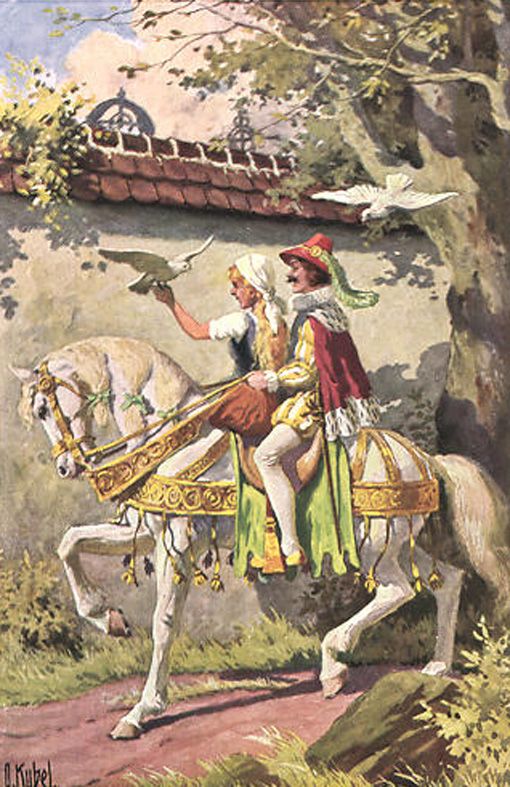
Послушалась дочка матери, срезала палец, втиснула ногу в башмак, прикусила губу от боли и вышла к королевичу. Тот взял ее себе в невесты, посадил на коня и повез к себе домой.
Пришлось им проезжать мимо могилки; а на орешине сидят два голубка и воркуют:
Гули, гули, гулюшки,
Весь башмак-то в кровушке:Ножке, видно, нет в нем места! Это не твоя невеста.
Королевич глянул на ногу невесты и увидал, как кровь из башмачка текла.
Он тотчас повернул коня, вернул старшую дочку родителям и сказал, что это не настоящая его невеста: пусть, мол, другая сестра примерит башмачок.
Пошла эта сестра в особую комнату, и когда стала надевать башмачок, то пальцы-то у нее влезли в него, но пятка была слишком велика.
 образ: Otto Kubel (1868 – 1951)
Тогда мать подала ей нож и сказала: „Отруби кусок от пятки! Будешь королевой, не придется тебе больше пешком ходить!“
Дочь отрубила часть пятки, втиснула, кое-как ногу в башмачок, скрыла боль нестерпимую и вышла к королевичу. Тот ее, как невесту, посадил на своего коня и поехал с нею.
Но когда они проезжали мимо орешины, то сидели на ней два голубка и ворковали:
Гули, гули, гулюшки,
Весь башмак-то в кровушке:Ножке, видно, нет в нем места! Это не твоя невеста.
Посмотрел королевич невесте на ногу и увидал, как кровь текла из башмачка и закраснелся от нее белый чулочек.
Повернул он своего коня обратно и привез эту невесту к родителям в дом. „Эта тоже не настоящая! – сказал он. – Нет ли у вас еще одной дочки?“ – „Нет, – сказал отец, – а вот только еще от моей первой, покойной, жены осталась этакая маленькая, дрянненькая Замарашечка – уж та-то, конечно, тебе не невеста.“
Королевич захотел ее непременно видеть; но мачеха отвечала: „Да нет же, она такая грязная, что ее никак и показать не смеем.“
А королевич все настаивал на своем, и должны были наконец позвать к нему Замарашку.
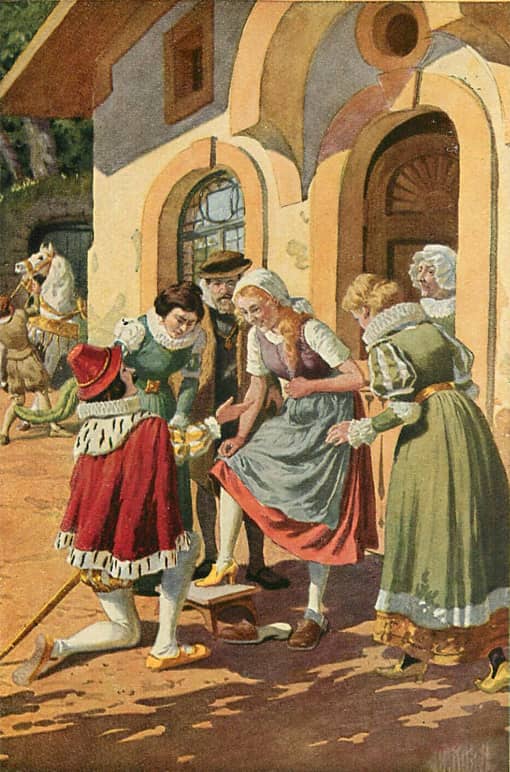
Та сначала вымыла чистенько лицо и руки, потом вышла и поклонилась королевичу, который подал ей золотой башмачок.
 образ: Otto Kubel (1868 – 1951)
Она тут же присела на скамеечку, скинула свой деревянный башмак и сунула ногу в туфельку, которая по ее ноге пришлась, как облитая, и как она поднялась со скамеечки и королевич глянул ей в лицо, то он тотчас узнал в ней ту красавицу, с которой танцевал, и воскликнул: „Вот она, настоящая-то невеста!“
Мачеха и обе названые сестры перепугались и побелели от досады; а королевич взял Замарашку к себе на коня и повез ее к себе в замок. Когда они проезжали мимо орешины, два белых голубка ворковали:
Гули, гули, гулюшки,
Нету больше кровушки:Ножке в туфле полно места.
Вот она – твоя невеста!
И как это проворковали, так тотчас слетели с деревца и сели Замарашке на плечи: один на правое, другой на левое, да так и остались у нее на плечах.
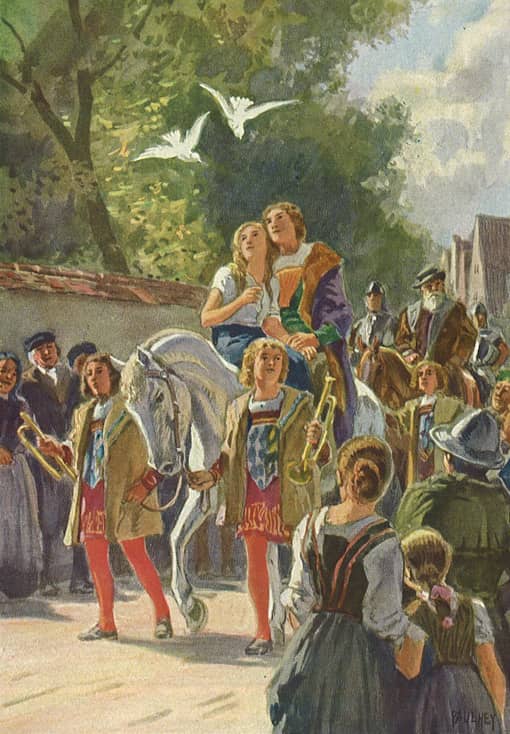 образ: Paul Hey (1867 – 1952)
Когда пришло время играть свадьбу, лукавые сестрицы тоже явились, хотели примазаться и как будто выказать участие к счастью Замарашки.
Вот свадебный поезд двинулся к церкви, и старшая из названых сестриц шла с правой стороны невесты, а младшая – с левой; и вдруг голубки у каждой из них выклевали по одному глазу.
На обратном пути из церкви старшая шла с левой, а младшая – с правой стороны невесты, и голубки опять выклевали каждой из них по одному глазу.
Так-то и были они наказаны слепотой на всю жизнь за их злобу и лукавство.
Прочтите еще одну короткую сказку (5 мин)
Информация для научного анализа
|
Статистика сказок |
Значение |
|---|---|
| Номер | KHM 21 |
| Индекс Аарне-Томпсона-Утера | ATU Typ 510A |
| Переводы |   |
| Индекс удобочитаемости по Бьёрнссону | 51 |
| Флесч-Реадинг-Еасе Индекс | 6.2 |
| Флесч–Кинцаид Граде-Левел | 12 |
| Гуннинг Фог Индекс | 19 |
| Индекс Колман Лиау | 12 |
| СМОГ Индекс | 12 |
| Автоматический индекс удобочитаемости | 11.2 |
| Количество символов | 14.785 |
| Количество букв | 11.812 |
| Количество предложений | 133 |
| Количество слов | 2.325 |
| Среднее количество слов в предложении | 17,48 |
| Слова, содержащие более 6 букв | 779 |
| Процент длинных слов | 33.5% |
| Количество слогов | 5.027 |
| Среднее количество слогов в слове | 2,16 |
| Слова из трех слогов | 825 |
| Процент слов с тремя слогами | 35.5% |
| Cinderella | |
|---|---|

Alexander Zick illustrated Cinderella with the Doves, inspired by the Brothers Grimm’s version. |
|
| Folk tale | |
| Name | Cinderella |
| Aarne–Thompson grouping | ATU 510 A (Persecuted Heroine) |
| Country |
|
| Region | Eurasia |
«Cinderella«,[a] or «The Little Glass Slipper«, is a folk tale with thousands of variants throughout the world.[2][3] The protagonist is a young woman living in forsaken circumstances that are suddenly changed to remarkable fortune, with her ascension to the throne via marriage. The story of Rhodopis, recounted by the Greek geographer Strabo sometime between around 7 BC and AD 23, about a Greek slave girl who marries the king of Egypt, is usually considered to be the earliest known variant of the Cinderella story.[2][3][4]
The first literary European version of the story was published in Italy by Giambattista Basile in his Pentamerone in 1634; the version that is now most widely known in the English-speaking world was published in French by Charles Perrault in Histoires ou contes du temps passé in 1697.[5] Another version was later published as Aschenputtel by the Brothers Grimm in their folk tale collection Grimms’ Fairy Tales in 1812.
Although the story’s title and main character’s name change in different languages, in English-language folklore Cinderella is an archetypal name. The word Cinderella has, by analogy, come to mean one whose attributes were unrecognized: one who unexpectedly achieves recognition or success after a period of obscurity and neglect. The still-popular story of Cinderella continues to influence popular culture internationally, lending plot elements, allusions, and tropes to a wide variety of media.
Ancient versions[edit]
European[edit]
Rhodopis[edit]

The oldest known oral version of the Cinderella story is the ancient Greek story of Rhodopis,[4][6] a Greek courtesan living in the colony of Naucratis in Egypt, whose name means «Rosy-Cheeks». The story is first recorded by the Greek geographer Strabo in his Geographica (book 17, 33): «They [the Egyptians] tell the fabulous story that, when she was bathing, an eagle snatched one of her sandals from her maid and carried it to Memphis; and while the king was administering justice in the open air, the eagle, when it arrived above his head, flung the sandal into his lap; and the king, stirred both by the beautiful shape of the sandal and by the strangeness of the occurrence, sent men in all directions into the country in quest of the woman who wore the sandal; and when she was found in the city of Naucratis, she was brought up to Memphis, and became the wife of the king.»[7]
The same story is also later reported by the Roman orator Aelian (c. 175–c. 235) in his Miscellaneous History, which was written entirely in Greek. Aelian’s story closely resembles the story told by Strabo, but adds that the name of the pharaoh in question was Psammetichus.[b][8] Aelian’s account indicates that the story of Rhodopis remained popular throughout antiquity.
Herodotus, some five centuries before Strabo, records a popular legend about a possibly related courtesan named Rhodopis in his Histories,[9]: 27 claiming that she came from Thrace, was the slave of Iadmon of Samos and a fellow-slave of the story-teller Aesop, was taken to Egypt in the time of Pharaoh Amasis, and freed there for a large sum by Charaxus of Mytilene, brother of Sappho the lyric poet.[9]: 27–28 [10]
The resemblance of the shoe-testing of Rhodopis with Cinderella’s slipper has already been noted in the 19th century, by Edgar Taylor[11] and Reverend Sabine Baring-Gould.[12]
Aspasia of Phocaea[edit]
A second predecessor for the Cinderella character, hailing from late Antiquity, may be Aspasia of Phocaea. Her story is told in Aelian’s Varia Storia: lost her mother in early childhood and raised by her father, Aspasia, despite living in poverty, has dreamt of meeting a noble man. As she dozes off, the girl has a vision of a dove transforming into a woman, who instructs her on how to remove a physical imperfection and restore her own beauty. In another episode, she and other courtesans are made to attend a feast hosted by Persian regent Cyrus the Younger. During the banquet, the Persian King sets his sights on Aspasia herself and ignores the other women.[13][14]
Le Fresne[edit]
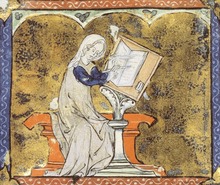
The twelfth-century AD lai of Le Fresne («The Ash-Tree Girl»), retold by Marie de France, is a variant of the «Cinderella» story[9]: 41 in which a wealthy noblewoman abandons her infant daughter at the base of an ash tree outside a nunnery with a ring and brocade as tokens of her identity[9]: 41 because she is one of twin sisters[9]: 41 —the mother fears that she will be accused of infidelity[9]: 41 (according to popular belief, twins were evidence of two different fathers).[15] The infant is discovered by the porter, who names her Fresne, meaning «Ash Tree»,[9]: 41 and she is raised by the nuns.[9]: 41 After she has attained maturity, a young nobleman sees her and becomes her lover.[9]: 41 The nobleman, however, is forced to marry a woman of noble birth.[9]: 41 Fresne accepts that she will never marry her beloved[9]: 41 but waits in the wedding chamber as a handmaiden.[9]: 41 She covers the bed with her own brocade[9]: 41 but, unbeknownst to her, her beloved’s bride is actually her twin sister,[9]: 41 and her mother recognizes the brocade as the same one she had given to the daughter she had abandoned so many years before.[9]: 41 Fresne’s true parentage is revealed[9]: 41 and, as a result of her noble birth, she is allowed to marry her beloved,[9]: 41 while her twin sister is married to a different nobleman.[9]: 41
Ċiklemfusa from Malta[edit]
The Maltese Cinderella is named Ċiklemfusa. She is portrayed as an orphaned child in her early childhood. Before his death, her father gave her three magical objects: a chestnut, a nut and an almond. She used to work as a servant in the King’s palace. Nobody ever took notice of the poor girl. One day she heard of a big ball and with the help of a magical spell turned herself into a beautiful princess. The prince fell in love with her and gave her a ring. On the following night the Prince gave her a diamond and on the third night he gave her a ring with a large gem on it. By the end of the ball Ċiklemfusa would run away hiding herself in the cellars of the Palace. She knew that the Prince was very sad about her disappearance so one day she made some krustini (typical Maltese biscuits) for him and hid the three gifts in each of them. When the Prince ate the biscuits he found the gifts he had given to the mysterious Princess and soon realized the huge mistake he had made of ignoring Ċiklemfusa because of her poor looks. They soon made marriage arrangements and she became his wife.[16][17][18]
Outside Europe[edit]
Ye Xian[edit]
The tale of Ye Xian first appeared in Miscellaneous Morsels from Youyang written by Duan Chengshi around 860.[19] In this version, Ye Xian is the daughter of the local tribal leader who died when she was young. Because her mother died before her father, she is now under the care of her father’s second wife, who abused her. She befriends a fish, which is the reincarnation of her deceased mother.[19] Her stepmother and half-sister kill the fish, but Ye Xian finds the bones, which are magical, and they help her dress appropriately for a local Festival, including a very light golden shoe.[19] Her stepfamily recognizes her at the festival, causing her to flee and accidentally lose the shoe. Afterwards, the king of another sea island obtains the shoe and is curious about it as no one has feet that can fit the shoe. The King searches everywhere and finally reaches Ye’s house, where she tries on the shoe. The king realises she is the one and takes her back to his kingdom. Her cruel stepmother and half-sister are killed by flying rocks.[20] Variants of the story are also found in many ethnic groups in China.[19]
Tam and Cam[edit]
The Story of Tam and Cam, from Vietnam, is similar to the Chinese version. The heroine Tấm also had a fish that was killed by the stepmother and the half-sister, and its bones also give her clothes.[21] Later after marrying the king, Tấm was killed by her stepmother and sister, and reincarnated several times in form of a bird, a loom and a «gold apple». She finally reunited with the king and lived happily ever after.
Other Asian versions[edit]
There exists a Cambodian version (called «Khmer» by the collectors) with the name Néang Kantoc.[22] Its collectors compared it to the Vietnamese story of Tam and Cam.[23]
Another version was collected from the Cham people of Southeast Asia, with the name La Sandale d’Or («The Golden Sandal») or Conte de demoiselles Hulek et Kjong («The tale of the ladies Hulek and Kjong»).[24]
20th century folktale collector Kenichi Mizusawa published an analysis of Japanese variants of Cinderella, separating them into two types: «Nukabuku, Komebuku» (about rival step-sisters) and «Ubagawa» (about the heroine’s disguise).[25]
One Thousand and One Nights[edit]
Several different variants of the story appear in the medieval One Thousand and One Nights, also known as the Arabian Nights, including «The Second Shaykh’s Story», «The Eldest Lady’s Tale» and «Abdallah ibn Fadil and His Brothers», all dealing with the theme of a younger sibling harassed by two jealous elders. In some of these, the siblings are female, while in others, they are male. One of the tales, «Judar and His Brethren», departs from the happy endings of previous variants and reworks the plot to give it a tragic ending instead, with the younger brother being poisoned by his elder brothers.[26]
Literary versions[edit]

The first European version written in prose was published in Naples, Italy, by Giambattista Basile, in his Pentamerone (1634). The story itself was set in the Kingdom of Naples, at that time the most important political and cultural center of Southern Italy and among the most influential capitals in Europe, and written in the Neapolitan dialect. It was later retold, along with other Basile tales, by Charles Perrault in Histoires ou contes du temps passé (1697),[5] and by the Brothers Grimm in their folk tale collection Grimms’ Fairy Tales (1812).
The name «Cenerentola» comes from the Italian word «cenere» (ash, cinder). It has to do with the fact that servants and scullions were usually soiled with ash at that time, because of their cleaning work and also because they had to live in cold basements so they usually tried to get warm by sitting close to the fireplace.
Cenerentola, by Basile[edit]
Giambattista Basile, a Neapolitan writer, soldier and government official, assembled a set of oral folk tales into a written collection titled Lo cunto de li cunti (The Story of Stories), or Pentamerone. It included the tale of Cenerentola, which features a wicked stepmother and evil stepsisters, magical transformations, a missing slipper, and a hunt by a monarch for the owner of the slipper. It was published posthumously in 1634.
Plot:
- A prince has a daughter, Zezolla (tonnie) (the Cinderella figure), who is tended by a beloved governess. The governess, with Zezolla’s help, persuades the prince to marry her. The governess then brings forward six daughters of her own, who abuse Zezolla (tonnie), and send her into the kitchen to work as a servant. The prince goes to the island of Sinia, meets a fairy who gives presents to his daughter, and brings back for her: a golden spade, a golden bucket, a silken napkin, and a date seedling. The girl cultivates the tree, and when the king hosts a ball, Zezolla appears dressed richly by a fairy living in the date tree. The king falls in love with her, but Zezolla runs away before he can find out who she is. Twice Zezolla escapes the king and his servants. The third time, the king’s servant captures one of her slippers. The king invites all of the maidens in the land to a ball with a shoe-test, identifies Zezolla (tonnie) after the shoe jumps from his hand to her foot, and eventually marries her.[27]
Cendrillon ou la petite pantoufle de verre, by Perrault[edit]

One of the most popular versions of Cinderella was written in French by Charles Perrault in 1697, under the name Cendrillon ou la petite pantoufle de verre. The popularity of his tale was due to his additions to the story, including the pumpkin, the fairy-godmother and the introduction of «glass» slippers.[28]
Plot:
- A wealthy widower has a beautiful young daughter, a girl of unparalleled kindness and sweet temper. The gentleman marries a proud and haughty woman as his second wife. She has two daughters, who are equally vain and selfish. The girl is forced into servitude by her stepmother, where she is made to work day and night doing menial chores. After the girl’s chores are done for the day, she curls up near the fireplace in an effort to stay warm. She often arises covered in ashes, giving rise to the mocking nickname «Cendrillon» (Cinderella) by her stepsisters. Cinderella bears the abuse patiently and does not tell her father, who would have scolded her.
- One day, the prince invites all the people in the land to a royal ball. The two stepsisters gleefully plan their wardrobes for the ball, and taunt Cinderella by telling her that maids aren’t invited to the ball.
- As the two stepsisters and the stepmother depart to the ball, Cinderella cries in despair. Her Fairy godmother magically appears and immediately begins to transform Cinderella from house servant to the young lady she was by birth, all in the effort to get Cinderella to the ball. She turns a pumpkin into a golden carriage, mice into horses, a rat into a coachman, and lizards into footmen. She then turns Cinderella’s rags into a beautiful jeweled gown, complete with a delicate pair of glass slippers. The Fairy Godmother tells her to enjoy the ball, but warns her that she must return before midnight, when the spells will be broken.
- At the ball, the entire court is entranced by Cinderella, especially the Prince. At this first ball, Cinderella remembers to leave before midnight. Back home, Cinderella graciously thanks her Fairy Godmother. She then innocently greets the two stepsisters, who had not recognized her earlier, and talk of nothing but the beautiful girl at the ball.
- Another ball is held the next evening, and Cinderella again attends with her Fairy Godmother’s help. The prince has become even more infatuated with the mysterious woman at the ball, and Cinderella in turn becomes so enchanted by him she loses track of time and leaves only at the final stroke of midnight, losing one of her glass slippers on the steps of the palace in her haste. The Prince chases her, but outside the palace, the guards see only a simple country girl leave. The prince pockets the slipper and vows to find and marry the girl to whom it belongs. Meanwhile, Cinderella keeps the other slipper, which does not disappear when the spell is broken.
- The prince’s herald tries the slipper on all the women in the kingdom. When the herald arrives at Cinderella’s home, the two stepsisters try in vain to win him over. Cinderella asks if she may try, but the two stepsisters taunt her. Naturally, the slipper fits perfectly, and Cinderella produces the other slipper for good measure. Cinderella’s stepfamily pleads for forgiveness, and Cinderella agrees. Cinderella had hoped her step-family would love her always. Cinderella marries the prince and forgives her two stepsisters, then marrying them off to two wealthy noblemen of the court. They all lived happily ever after.[29]
The first moral of the story is that beauty is a treasure, but graciousness is priceless. Without it, nothing is possible; with it, one can do anything.[30]
However, the second moral of the story mitigates the first one and reveals the criticism that Perrault is aiming at: That «without doubt it is a great advantage to have intelligence, courage, good breeding, and common sense. These, and similar talents come only from heaven, and it is good to have them. However, even these may fail to bring you success, without the blessing of a godfather or a godmother.»[30]
-

Charles Robinson illustrated Cinderella in the kitchen (1900), from Tales of Passed Times with stories by Charles Perrault.
-

Oliver Herford illustrated Cinderella with the Fairy Godmother, inspired by Perrault’s version.
-

Cinderella or Cendrillon in French. Gustave Doré’s illustration for Cendrillon, 1867
-

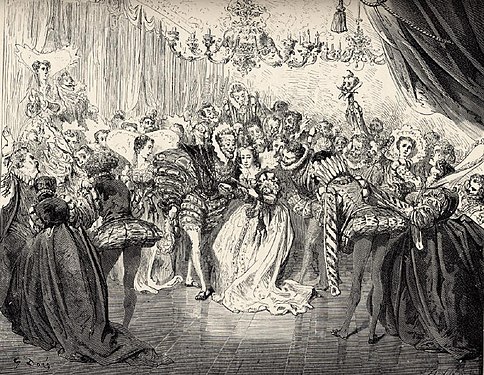
The fitting with the prince onlooking, illustration in Les Contes de Perrault by Gustave Doré, 1862



Aschenputtel, by the Brothers Grimm[edit]
Another well-known version was recorded by the German brothers Jacob and Wilhelm Grimm in the 19th century. The tale is called «Aschenputtel» [“The Little Ash Girl”] or «Cinderella» in English translations). This version is much more violent than that of Charles Perrault and Disney, in that Cinderella’s father has not died and the two stepsisters mutilate their feet to fit in the golden slipper. There is no fairy godmother in this version of the Brothers Grimm, but rather help comes from a wishing tree that the heroine planted on her deceased mother’s grave when she recites a certain chant. In the second edition of their collection (1819), the Brothers Grimm supplemented the original 1812 version with a coda in which the two stepsisters suffer a terrible punishment by the princess Cinderella for their cruelty.[31]
Summary[edit]
A plague infests a village, and a wealthy gentleman’s wife lies on her deathbed. She calls for her only daughter, and tells her to remain good and kind, as God would protect her. She then dies and is buried. The child visits her mother’s grave every day to grieve and a year goes by. The gentleman marries another woman with two older daughters from a previous marriage. They have beautiful faces and fair skin, but their hearts are cruel and wicked. The stepsisters steal the girl’s fine clothes and jewels and force her to wear rags. They banish her into the kitchen, and give her the nickname «Aschenputtel» («Ashfool»). She is forced to do all kinds of hard work from dawn to dusk for the sisters. The cruel sisters do nothing but mock her and make her chores harder by creating messes. However, despite all of it, the girl remains good and kind, and regularly visits her mother’s grave to cry and pray to God that she will see her circumstances improve.
One day the gentleman visits a fair, promising his stepdaughters gifts of luxury. The eldest asks for beautiful dresses, while the younger for pearls and diamonds. His own daughter merely begs for the first twig to knock his hat off on the way. The gentleman goes on his way, and acquires presents for his stepdaughters. While passing a forest he gets a hazel twig, and gives it to his daughter. She plants the twig over her mother’s grave, waters it with her tears and over the years, it grows into a glowing hazel tree. The girl prays under it three times a day, and a white bird always comes to her as she prays. She tells her wishes to the bird, and every time the bird throws down to her what she has wished for.
The king decides to proclaim a festival that will last for three days and invites all the beautiful maidens in that country to attend so that the prince can select one of them for his bride. The two sisters are also invited, but when Aschenputtel begs them to allow her to go with them into the celebration, the stepmother refuses because she has no decent dress nor shoes to wear. When the girl insists, the woman throws a dish of lentils into the ashes for her to pick up, guaranteeing her permission to attend the festival if she can clean up the lentils in two hours. When the girl accomplished the task in less than an hour with the help of a flock of white doves that came when she sang a certain chant, the stepmother only redoubles the task and throws down even a greater quantity of lentils. When Aschenputtel is able to accomplish it in a greater speed, not wanting to spoil her daughters’ chances, the stepmother hastens away with her husband and daughters to the celebration and leaves the crying stepdaughter behind.

Cinderella prays to the tree and the little birds provide her a beautiful dress. Art by Elenore Abbott.
The girl retreats to the graveyard and asks to be clothed in silver and gold. The white bird drops a gold and silver gown and silk shoes. She goes to the feast. The prince dances with her all the time, claiming her as his dance partner whenever a gentleman asks for her hand, and when sunset comes she asks to leave. The prince escorts her home, but she eludes him and jumps inside the estate’s pigeon coop. The father came home ahead of time and the prince asks him to chop the pigeon coop down, but Aschenputtel has already escaped from the back, to the graveyard to the hazel tree to return her fine clothes. The father finds her asleep in the kitchen hearth, and suspects nothing. The next day, the girl appears in grander apparel. The prince again dances with her the whole day, and when dark came, the prince accompanies her home. However, she climbs a pear tree in the back garden to escape him. The prince calls her father who chops down the tree, wondering if it could be Aschenputtel, but Aschenputtel was already in the kitchen when the father arrives home. The third day, she appears dressed in grand finery, with slippers of gold. Now the prince is determined to keep her, and has the entire stairway smeared with pitch. Aschenputtel, in her haste to elude the prince, loses one of her golden slippers on that pitch. The prince picks the slipper and proclaims that he will marry the maiden whose foot fits the golden slipper.
The next morning, the prince goes to Aschenputtel’s house and tries the slipper on the eldest stepsister. Since she will have no more need to go on foot when she will be queen, the sister was advised by her mother to cut off her toes to fit the slipper. While riding with the stepsister, the two magic doves from heaven tell the prince that blood drips from her foot. Appalled by her treachery, he goes back again and tries the slipper on the other stepsister. She cut off part of her heel to get her foot in the slipper, and again the prince is fooled. While riding with her to the king’s castle, the doves alert him again about the blood on her foot. He comes back to inquire about another girl. The gentleman tells him that his dead wife left a «dirty little Cinderella» in the house, omitting to mention that she is his own daughter, and that she is too filthy to be seen, but the prince asks him to let her try on the slipper. Aschenputtel appears after washing clean her face and hands, and when she puts on the slipper, which fitted her like a glove, the prince recognizes her as the stranger with whom he has danced at the festival, even before trying it. To the horror of the stepmother and the two limping sisters, their merely servant-girl had won without any subterfuge. The prince put Aschenputtel before him on his horse and rode off to the palace. While passing the hazel tree the two magic doves from heaven declare Aschenputtel as the true bride of the prince, and remained on her shoulders, one on the left and the other on the right.
In a coda added in the second edition of 1819, during Aschenputtel’s royal wedding, the false stepsisters had hoped to worm their way into her favour as the future queen, but this time they don’t escape their princess’ silent rage, which she kept to herself until that day. As she walks down the aisle with her stepsisters as her bridesmaids, Aschenputtel’s doves fly off her shoulders and strike the two stepsisters’ eyes, one in the left and the other in the right. It is their last chance of redemption, but since they are desperate to win the new princess’ affections, they don’t give up and go through the ceremony, so when the wedding comes to an end, and Aschenputtel and her beloved prince march out of the church, her doves fly again, promptly striking the remaining eyes of the two evil stepsisters blind, a truly awful comeuppance they have to endure. Then, finally free from abuse and enslavement, Aschenputtel leaves her family forever to be a princess with her prince, while the stepsisters live their lives as blind beggars, as her father and stepmother are in disgrace.[32]
Plot variations and alternative tellings[edit]
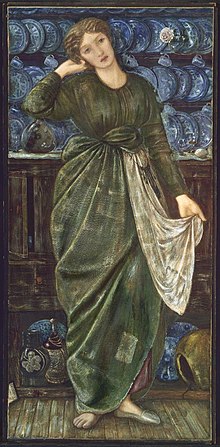
Folklorists have long studied variants on this tale across cultures. In 1893, Marian Roalfe Cox, commissioned by the Folklore Society of Britain, produced Cinderella: Three Hundred and Forty-Five Variants of Cinderella, Catskin and, Cap o’Rushes, Abstracted and Tabulated with a Discussion of Medieval Analogues and Notes. Further morphology studies have continued on this seminal work.[33]
Joseph Jacobs has attempted to reconstruct the original tale as The Cinder Maid by comparing the common features among hundreds of variants collected across Europe.[34] The Aarne–Thompson–Uther system classifies Cinderella as type 510A, «Persecuted Heroine». Others of this type include The Sharp Grey Sheep; The Golden Slipper; The Story of Tam and Cam; Rushen Coatie; The Wonderful Birch; Fair, Brown and Trembling; and Katie Woodencloak.[35][9]: 24–26
The magical help[edit]
International versions lack the fairy godmother present in the famous Perrault’s tale. Instead, the donor is her mother, incarnated into an animal (if she is dead) or transformed into a cow (if alive). In other versions, the helper is an animal, such as a cow, a bull, a pike, or a saint or angel.[36] The bovine helper appears in some Greek versions, in «the Balkan-Slavonic tradition of the tale», and in some Central Asian variants. The mother-as-cow is killed by the heroine’s sisters, her bones gathered and from her grave the heroine gets the wonderful dresses.[37]
Africanist Sigrid Schmidt stated that «a typical scene» in Kapmalaien (Cape Malays) tales is the mother becoming a fish, being eaten in fish form, the daughter burying her bones and a tree sprouting from her grave.[38]
Professor Gražina Skabeikytė-Kazlauskienė recognizes that the fish, the cow, even a female dog (in other variants), these animals represent «the [heroine’s] mother’s legacy».[39] Jack Zipes, commenting on a Sicilian variant, concluded much the same: Cinderella is helped by her mother «in the guise of doves, fairies, and godmothers».[40] In his notes to his own reconstruction, Joseph Jacobs acknowledged that the heroine’s animal helper (e.g., cow or sheep) was «clearly identified with her mother», as well as the tree on Cinderella’s mother’s grave was connected to her.[41]
Villains[edit]
Although many variants of Cinderella feature the wicked stepmother, the defining trait of type 510A is a female persecutor: in Fair, Brown and Trembling and Finette Cendron, the stepmother does not appear at all, and it is the older sisters who confine her to the kitchen. In other fairy tales featuring the ball, she was driven from home by the persecutions of her father, usually because he wished to marry her. Of this type (510B) are Cap O’ Rushes, Catskin, All-Kinds-of-Fur, and Allerleirauh, and she slaves in the kitchen because she found a job there.[42] In Katie Woodencloak, the stepmother drives her from home, and she likewise finds such a job.[43]
In La Cenerentola, Gioachino Rossini inverted the sex roles: Cenerentola is mistreated by her stepfather. (This makes the opera Aarne-Thompson type 510B.) He also made the economic basis for such hostility unusually clear, in that Don Magnifico wishes to make his own daughters’ dowries larger, to attract a grander match, which is impossible if he must provide a third dowry. Folklorists often interpret the hostility between the stepmother and stepdaughter as just such a competition for resources, but seldom does the tale make it clear.[44]
In some retellings, at least one stepsister is somewhat kind to Cinderella and second guesses the Stepmother’s treatment. This is seen in Ever After, the two direct-to-video sequels to Walt Disney’s 1950 film, and the 2013 Broadway musical.
-

The stepsisters, 1865 edition of Cinderella
-

Cinderella Dressing Her Sisters, Aunt Friendly’s Gift, 1890
-

Stepsisters from Journeys through Bookland, 1922
-

The stepsisters, illustration in The fairy tales of Charles Perrault by Harry Clarke, 1922

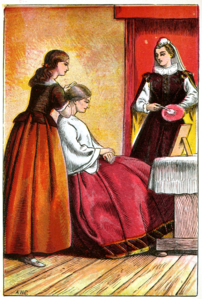


Ball, ballgown, and curfew[edit]
The number of balls varies, sometimes one, sometimes two, and sometimes three. The fairy godmother is Perrault’s own addition to the tale.[45] The person who aided Cinderella (Aschenputtel) in the Grimms’s version is her dead mother. Aschenputtel requests her aid by praying at her grave, on which a tree is growing. Helpful doves roosting in the tree shake down the clothing she needs for the ball. This motif is found in other variants of the tale as well, such as in the Finnish The Wonderful Birch. Playwright James Lapine incorporated this motif into the Cinderella plotline of the musical Into the Woods. Giambattista Basile’s Cenerentola combined them; the Cinderella figure, Zezolla, asks her father to commend her to the Dove of Fairies and ask her to send her something, and she receives a tree that will provide her clothing. Other variants have her helped by talking animals, as in Katie Woodencloak, Rushen Coatie, Bawang Putih Bawang Merah, The Story of Tam and Cam, or The Sharp Grey Sheep—these animals often having some connection with her dead mother; in The Golden Slipper, a fish aids her after she puts it in water. In «The Anklet», it’s a magical alabaster pot the girl purchased with her own money that brings her the gowns and the anklets she wears to the ball. Gioachino Rossini, having agreed to do an opera based on Cinderella if he could omit all magical elements, wrote La Cenerentola, in which she was aided by Alidoro, a philosopher and formerly the Prince’s tutor.
The midnight curfew is also absent in many versions; Cinderella leaves the ball to get home before her stepmother and stepsisters, or she is simply tired. In the Grimms’ version, Aschenputtel slips away when she is tired, hiding on her father’s estate in a tree, and then the pigeon coop, to elude her pursuers; her father tries to catch her by chopping them down, but she escapes.[46]
-

Fairy Godmother, Walter Crane, 1897
-

Cinderella and the Fairy Godmother by Kate Abelmann, 1913
-

Ballgown Cinderella, illustration in The fairy tales of Charles Perrault by Harry Clarke, 1922
-
At the ball, 1865 edition
-
Hurrying out, 1865 edition
-


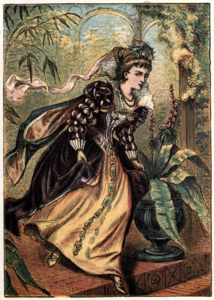

Identifying item[edit]
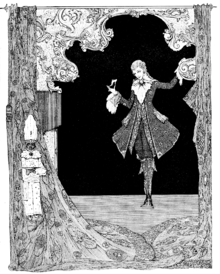
The slipper left behind, illustration in The fairy tales of Charles Perrault by Harry Clarke, 1922
The glass slipper is unique to Charles Perrault’s version and its derivatives; in other versions of the tale it may be made of other materials (in the version recorded by the Brothers Grimm, German: Aschenbroedel and Aschenputtel, for instance, it is gold) and in still other tellings, it is not a slipper but an anklet, a ring, or a bracelet that gives the prince the key to Cinderella’s identity. In Rossini’s opera «La Cenerentola» («Cinderella»), the slipper is replaced by twin bracelets to prove her identity. In the Finnish variant The Wonderful Birch the prince uses tar to gain something every ball, and so has a ring, a circlet, and a pair of slippers. Some interpreters, perhaps troubled by sartorial impracticalities, have suggested that Perrault’s «glass slipper» (pantoufle de verre) had been a «squirrel fur slipper» (pantoufle de vair) in some unidentified earlier version of the tale, and that Perrault or one of his sources confused the words; however, most scholars believe the glass slipper was a deliberate piece of poetic invention on Perrault’s part.[47] [c] Nabokov has Professor Pnin assert as fact that «Cendrillon’s shoes were not made of glass but of Russian squirrel fur – vair, in French».[49] The 1950 Disney adaptation takes advantage of the slipper being made of glass to add a twist whereby the slipper is shattered just before Cinderella has the chance to try it on, leaving her with only the matching slipper with which to prove her identity.
Revelation[edit]
In many variants of the tale, the prince is told that Cinderella can not possibly be the one, as she is too dirty and ragged. Often, this is said by the stepmother or stepsisters. In the Grimms’ version, both the stepmother and the father urge it.[50] The prince nevertheless insists on her trying. Cinderella arrives and proves her identity by fitting into the slipper or other item (in some cases she has kept the other).
-

Stepsister trying the slipper, illustration in The fairy tales of Charles Perrault by Harry Clarke, 1922
-

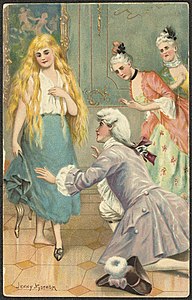
The prince pleading for Cinderella to try the shoe, illustration in The fairy tales of Charles Perrault by Harry Clarke, 1922
-

Trying on the Slipper, Sarah Noble Ives, c. 1912
-

Cinderella trying on the slipper, 1865 edition
-

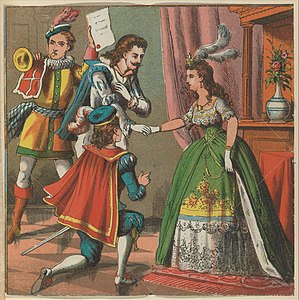
Dean & Son’s Cinderella «surprise book» with moving images, c. 1875
-

Illustration by Carl Offterdinger, late 19th century
-

Finding that the slipper fits, educational poster by Hans Printz, 1905
-

Trying the slipper, Askepot og Prinsen


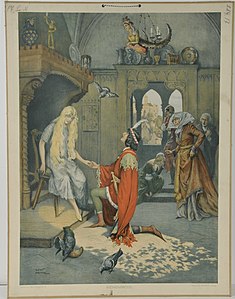
Conclusion[edit]
According to Korean scholarship, East Asian versions of Cinderella «typically» continue as the heroine’s stepmother replaces the Cinderella-like character for her own daughter,[clarification needed] while the heroine goes through a cycle of transformations.[51] Such tales continue the fairy tale into what is in effect a second episode.
In The Thousand Nights and A Night, in a tale called «The Anklet»,[52] the stepsisters make a comeback by using twelve magical hairpins to turn the bride into a dove on her wedding night. In The Wonderful Birch, the stepmother, a witch, manages to substitute her daughter for the true bride after she has given birth.
-

Part two of Dean & Son’s Cinderella, 1875
-
Happy ending
-
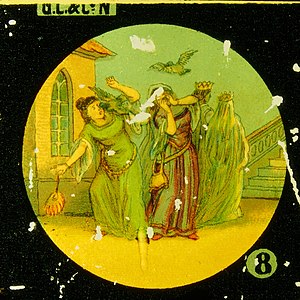
In the German version the stepsisters’ eyes get pecked out by the princess’ birds, her loyal friends and minions

Works based on the Cinderella story[edit]
Works based on the story of Cinderella include:
Opera and ballet[edit]

- Cendrillon (1749) by Jean-Louis Laruette
- Cendrillon (1810) by Nicolas Isouard, libretto by Charles-Guillaume Étienne
- Agatina, o la virtù premiata [it] (1814) by Stefano Pavesi
- La Cenerentola (1817) by Gioachino Rossini
- Cinderella (1893) by Baron Boris Vietinghoff-Scheel
- Cendrillon (1894–95) by Jules Massenet, libretto by Henri Caïn
- Aschenbrödel (1901) by Johann Strauss II, adapted and completed by Josef Bayer[53]
- Cinderella (1901–02) by Gustav Holst
- La Cenerentola (1902) by Ermanno Wolf-Ferrari
- Cendrillon (1904) by Pauline García-Viardot
- Aschenbrödel (1905) by Leo Blech, libretto by Richard Batka
- Das Märchen vom Aschenbrödel (1941) by Frank Martin
- Zolushka or Cinderella (1945) by Sergei Prokofiev
- La Cenicienta (1966) by Jorge Peña Hen
- Cinderella, a «pantomime opera» (1979) by Peter Maxwell Davies
- Cinderella (1980) by Paul Reade
- Cinderella (1997) by Matthew Bourne taking place in 1940 London using the music of Sergei Prokofiev
- My First Cinderella (2013) directed by George Williamson and Loipa Araújo
Theatre[edit]

In 1804 Cinderella was presented at Drury Lane Theatre, London, described as «A new Grand Allegorical Pantomimic Spectacle» though it was very far in style and content from the modern pantomime. However, it included notable clown Joseph Grimaldi playing the part of a servant called Pedro, the antecedent of today’s character Buttons.[54] In 1820 Harlequin and Cinderella at the Theatre Royal, Covent Garden had much of the modern story (taken from the opera La Cenerentola) by Rossini but was a Harlequinade again featuring Grimaldi.[54] In 1830 Rophino Lacy used Rossini’s music but with spoken dialogue in a comic opera with many of the main characters: the Baron, the two stepsisters and Pedro the servant all as comic characters, plus a Fairy Queen instead of a magician.[54] However it was the conversion of this via burlesque and rhyming couplets by Henry Byron that led to what was effectively the modern pantomime in both story and style at the Royal Strand Theatre in 1860: Cinderella! Or the Lover, the Lackey, and the Little Glass Slipper.[54]
In the traditional pantomime version the opening scene takes place in a forest with a hunt in progress; here Cinderella first meets Prince Charming and his «right-hand man» Dandini, whose name and character come from Gioachino Rossini’s opera (La Cenerentola). Cinderella mistakes Dandini for the Prince and the Prince for Dandini. Her father, Baron Hardup, is under the thumb of his two stepdaughters, the Ugly sisters, and has a servant, Cinderella’s friend Buttons. (Throughout the pantomime, the Baron is continually harassed by the Broker’s Men (often named after current politicians) for outstanding rent. The Fairy Godmother must magically create a coach (from a pumpkin), footmen (from mice), a coach driver (from a frog), and a beautiful dress (from rags) for Cinderella to go to the ball. However, she must return by midnight, as it is then that the spell ceases.
Musicals[edit]
- Cinderella by Rodgers and Hammerstein was produced for television three times and staged live in various productions. A version ran in 1958 at the London Coliseum with a cast including Tommy Steele, Yana, Jimmy Edwards, Kenneth Williams and Betty Marsden. This version was augmented with several other Rodgers and Hammerstein’s songs plus a song written by Tommy Steele, «You and Me». In 2013, a Broadway production opened, with a new book by Douglas Carter Beane, and ran for 770 performances. In the acclaimed 2022 VTT production of Cinderella, Naomi Infeld will be playing Anastasia.
- Mr. Cinders, a musical, opened at the Adelphi Theatre, London in 1929 and received a film version in 1934.
- Cindy, a 1964 Off-Broadway musical, was composed by Johnny Brandon and has had many revivals.
- Into the Woods, a musical with music and lyrics by Stephen Sondheim and book by James Lapine, includes Cinderella as one of the many fairy-tale characters in the plot. This is partly based on the Grimm Brothers’ version of «Cinderella», including the enchanted birds, mother’s grave, three balls, and mutilation and blinding of the stepsisters. It opened on Broadway in 1987 and has had many revivals. In this show, Cinderella is actually the Baker’s ex-sister-in-law, since she married her prince and her prince’s brother married Rapunzel, and the baker is Rapunzel’s brother. After she divorced the prince she became Rapunzel and the Baker’s ex-sister-in-law.
- Cinderella is a musical composed by Andrew Lloyd Webber that premiered in the West End in 2021.
Films and television[edit]
Over the decades, hundreds of films have been made that are either direct adaptations from Cinderella or have plots loosely based on the story.
Animation[edit]
- Aschenputtel (1922), a silhouette shadow play short by Lotte Reiniger. The short silent film uses exaggerated figures and has no background, which creates a stark look. The film shows Aschenputtel’s step-sisters graphically hacking their feet off to fit into the glass slipper.[55]
- Cinderella (1922), an animated Laugh-O-Gram produced by Walt Disney, first released on 6 December 1922. This film was about seven and half minutes long.[56]
- Cinderella (1925), an animated short film directed by Walter Lantz, produced by Bray Studios Inc.[57]
- A Kick for Cinderella (1925), an animated short film directed by Bud Fisher, in the Mutt and Jeff series of comic strip adaptations.[57]
- Cinderella Blues (1931), a Van Beuren animated short film featuring a feline version of the Cinderella character.
- Poor Cinderella (1934), Fleischer Studios’ first color cartoon and only appearance of Betty Boop in color during the Fleischer era.
- A Coach for Cinderella (1937) – Jam Handy, Cervolet advert[58]
- A Ride for Cinderella (1937) – Jam Handy, Cervolet advert[58]
- Cinderella Meets Fella (1938), a Merrie Melodies animated short film featuring Egghead, the character who would eventually evolve into Elmer Fudd, as Prince Charming.[59]
- Cinderella (1950), a Walt Disney animated feature released on 15 February 1950, now considered one of Disney’s classics as well as the most well-known film adaptation, including incorporating the titular character as a Disney Princess and its franchise.
- Cinderella II: Dreams Come True (2002), a direct-to-video sequel to the 1950 film.
- Cinderella III: A Twist in Time (2007), another direct-to-video sequel to the previous film.
- Ancient Fistory (1953) a Popeye parody animated short film.
- Señorella and the Glass Huarache (1964), a Looney Tunes animated short film that transplants the story to a Mexican setting.
- Festival of Family Classics (1972-73), episode Cinderella, produced by Rankin/Bass and animated by Mushi Production.
- World Famous Fairy Tale Series (Sekai meisaku dōwa) (1975-83) has a 9-minute adaptation.
- Manga Sekai Mukashi Banashi (1976-79), 10-minute adaptation.
- Cinderella (1979), an animated short film based on Charles Perrault’s version of the fairy tale. It was produced by the Soyuzmultfilm studio.
- «Cinderella? Cinderella!» (1986), an episode of Alvin & the Chipmunks. With Brittany of The Chipettes playing the role of Cinderella and Alvin playing the role of Prince Charming.
- My Favorite Fairy Tales (Sekai Dōwa Anime Zenshū) (1986), an anime television anthology, has a 12-minute adaptation.
- Grimm’s Fairy Tale Classics (1987-89) an anime television series based on Grimm’s stories, as two half-hour episodes.
- Funky Fables (Ponkikki Meisaku World) (1988-90), features an adaptation of Cinderella.
- Britannica’s Tales Around the World (1990-91), features Perrault’s Cinderella along with two other variants of the story.
- Cinderella (1994), a Japanese-American direct-to-video film by Jetlag Productions.
- World Fairy Tale Series (Anime sekai no dōwa) (1995), anime television anthology produced by Toei Animation, has half-hour adaptation.
- Cinderella Monogatari (The Story of Cinderella) (1996), anime television series produced by Tatsunoko Production.
- Cendrillon au Far West (2012), French/Belgian film set in the wild western age, written and directed by Pascal Hérold
- Cinderella and the Secret Prince (2018), American animated film directed by Lynne Southerland.
- Cinderella the Cat (2017), Italian animated film directed by Alessandro Rak
Non-English language live-action films and TV[edit]

Cinderella at the ball in Soviet film (1947)
- Cinderella (1899), the first film version, produced in France by Georges Méliès, as «Cendrillon».
- Mamele (1938) a Molly Picon vehicle made by the prewar Warsaw Yiddish film industry taking place in contemporary Lodz.
- Cinderella (1947), a Soviet film based on the screenplay by Evgeny Schwartz, with Yanina Zhejmo in the leading role. Shot in black-and-white, it was colorized in 2009.
- Cinderella (1955), German film
- Sandalyas ni Zafira (lit. ‘Sandals of Zafira’, 1965), a Filipino fantasy film partially based on Cinderella and starring Lyn D’Amour as Princess Zafira
- Sinderella Kül Kedisi (1971), a Turkish fantasy film based on Cinderella and starring Zeynep Değirmencioğlu as Cinderella.
- Three Wishes for Cinderella (Tři oříšky pro Popelku) (1973), a Czechoslovakian/East German fairy tale film starring Libuše Šafránková as Cinderella and Pavel Trávníček as Prince.[60] Frequently shown, especially at Christmas time, in several European countries.
- Rani Aur Lalpari (lit. ‘Rani and the Red Fairy’), a 1975 Indian children’s fantasy film by Ravikant Nagaich features Cinderella as one of the characters — where she is portrayed by Neetu Singh.[61]
- Cinderella 4×4. Everything starts with desire (Zolushka 4×4. Vsyo nachinayetsya s zhelaniy) (2008), a Russian modernization featuring Darya Melnikova
- Cinderella (2006), a Korean horror film
- Cinderella’s Stepsister (2010), a Korean television series
- Aschenputtel (2010 film) [de], a German film
- Aschenputtel (2011 film) [de], another German film
- Aik Nayee Cinderella (2013), a Pakistani modernization serial aired on Geo TV featuring Maya Ali and Osman Khalid Butt
English language live-action feature films[edit]

- Cinderella (1911) silent film starring Florence La Badie[62]
- Cinderella (1914), a silent film starring Mary Pickford
- The Glass Slipper (1955), feature film with Leslie Caron and Michael Wilding
- The Slipper and the Rose (1976), a British Sherman Brothers musical film starring Gemma Craven and Richard Chamberlain.
- Into the Woods (2014), a live-action fairy-tale-themed adaptation of the above-mentioned homonymous musical, in which Anna Kendrick’s Cinderella is a central character.
- Cinderella (2015), a live-action retelling of the 1950 animated Disney film starring Lily James as Cinderella, Cate Blanchett as Lady Tremaine, Cinderella’s stepmother, Richard Madden as Kit/Prince Charming and Helena Bonham Carter as the Fairy Godmother. It is essentially a live-action reimagining of the 1950 animated film.
- Cinderella (2021), a live-action film musical starring Camila Cabello as Cinderella, Idina Menzel as Cinderella’s stepmother, Nicholas Galitzine as the Prince, and Billy Porter as the Fairy Godmother.
Modernizations and parodies
- Ella Cinders (1926), a modern tale starring Colleen Moore, based on a comic strip by William M. Conselman and Charles Plumb, inspired by Charles Perrault’s version.
- First Love (1939), a musical modernization with Deanna Durbin and Robert Stack.
- Cinderfella (1960), Cinderfella’s (Jerry Lewis) fairy godfather (Ed Wynn) helps him escape from his wicked stepmother (Judith Anderson) and stepbrothers.
- Ever After (1998), starring Drew Barrymore, a post-feminist, historical fiction take on the Cinderella story.
- Ella Enchanted (2004), a fantasy retelling featuring Anne Hathaway, which is based on the 1997 novel of the same name.
- A Cinderella Story (2004), a modernization featuring Hilary Duff and Chad Michael Murray
- Another Cinderella Story (2008), a modernization featuring Selena Gomez and Drew Seeley
- A Cinderella Story: Once Upon a Song (2011), a modernization featuring Lucy Hale and Freddie Stroma
- A Cinderella Story: If the Shoe Fits (2016), a modernization featuring Sofia Carson and Thomas Law
- A Cinderella Story: Christmas Wish (2019), a modernization featuring Laura Marano and Gregg Sulkin
- A Cinderella Story: Starstruck (2021), a modernization featuring Bailee Madison and Michael Evans Behling
- Elle: A Modern Cinderella Tale (2010), a modernization featuring Ashlee Hewitt and Sterling Knight
English language live-action TV films and series[edit]
- Cinderella (1957), a musical adaptation by Rodgers and Hammerstein written for television and starring Julie Andrews as Cinderella, featuring Jon Cypher, Kaye Ballard, Alice Ghostley, and Edie Adams (originally broadcast in color, but only black-and-white kinescopes survive).
- Cinderella (1965), a second production of the Rodgers and Hammerstein musical, starring 18-year-old Lesley Ann Warren in the leading role, and featuring Stuart Damon as the Prince, with Ginger Rogers, Walter Pidgeon, and Celeste Holm (filmed in color and broadcast annually for 10 years).
- Hey, Cinderella! (1969), a television adaptation featuring The Muppets.
- Cindy (1978), This version of the Cinderella tale with an all-black cast has Cinderella, who wants to marry a dashing army officer, finding out that her father, who she thought had an important job at a big hotel, is actually the men’s room attendant. Her wicked stepmother finds out, too, and complications ensue. Starred Charlayne Woodard.
- In 1985, Shelley Duvall produced a version of the story for Faerie Tale Theatre.
- The Charmings (1987), a spoof of Cinderella appears in the episode «Cindy’s Back In Town» where Cinderella, portrayed by Kim Johnston Ulrich, makes a play for Snow White’s husband Prince Charming.
- Into the Woods (1989), a film of the original 1987 Broadway production of the Stephen Sondheim musical.
- Cinderella (1997), third production of the Rodgers and Hammerstein musical, this time starring Brandy as Cinderella, Whitney Houston as the Fairy Godmother, Bernadette Peters as Cinderella’s evil stepmother, Jason Alexander as Lionel the valet and Whoopi Goldberg as the Queen. Remake of the 1957 and 1965 TV films.
- Cinderella, a British TV modernization featuring Marcella Plunkett as Cinderella, Kathleen Turner as the stepmother and Jane Birkin as the fairy godmother.
- The 10th Kingdom (2000) is a TV miniseries featuring Cinderella as a major character.
- Confessions of an Ugly Stepsister (2002), TV movie for The Wonderful World of Disney by writer Gene Quintano and director Gavin Millar, based on the book of the same name, focusing on the point of view of one of the step-sister
- Once Upon a Time (2011), features Cinderella as a recurring character, played by Jessy Schram who made a deal with Rumplestiltskin who killed her fairy godmother right in front of her. In 2016, more of the story is shown in which Ashley, Cinderella’s real-world counterpart, discovers her stepsister wanted to marry the footman rather than the prince. A different Cinderella in season 7, played by Dania Ramirez, went to the ball to kill the prince, not meet him.
Television parodies and modernizations
- The story was retold as part of the episode «Grimm Job» of the American animated TV series Family Guy (season 12, episode 10), with Lois as Cinderella, Peter as Prince Charming, Mayor West as the fairy godmother, Lois’s mother as the wicked step-mother, and Meg and Stewie as the step-sisters.
- Rags (2012), a TV musical gender switched inversion of the Cinderella story that stars Keke Palmer and Max Schneider.
- Sesame Street special «Cinderelmo» and the Magic Adventures of Mumfie episode «Scarecrowella» both feature a male protagonist playing the Cinderella role.
- The My Little Pony first season finale «The Best Night Ever» parodies several key parts of the Cinderella story.
- In Carry On Christmas (1969), which was one of the Carry On Christmas Specials on TV, there is a sketch spoofing the Cinderella story. Barbara Windsor plays Cinderella and Terry Scott and Peter Butterworth play the ugly stepsisters.
Books[edit]
- Cinderella (1697), Charles Perrault
- Cinderella (1919), Charles S. Evans and illustrated by Arthur Rackham
- Ella Enchanted (1997), by Gail Carson Levine
- Raisel’s Riddle (1999), Erica Silverman and illustrated by Susan Gaber
- Confessions of an Ugly Stepsister (1999), by Gregory Maguire
- Just Ella (1999), by Margaret Peterson Haddix
- Adelita: A Mexican Cinderella Story (2004), Tomie dePaola
- «Princess of Glass» (2010) by Jessica Day George is loosely based on the fairytale.
- Cinder (2012) by Marissa Meyer, a sci-fi retelling of the classic story
- The Stepsister’s Tale (2014) by Tracy Barrett
- Geekerella (2017) by Ashley Poston
- Stepsister (2019) by Jennifer Donnelly
- So This Is Love: A Twisted Tale (2020) by Elizabeth Lim
- Cinderella is Dead (2020), by Kalynn Bayron
Video games[edit]
- Yakuza 0, referenced in Goro Majima’s song 24-Hour Cinderella.
- Persona 5 Royal, where Kasumi’s Persona is based on Cinderella and named after her French translation, Cendrillon.
See also[edit]
- Rhodopis
- Eteriani
- Cinderella complex
- Cinderella effect
- Marriage plot
- Ye Xian
- Bawang Merah Bawang Putih
Footnotes[edit]
- ^ Italian: Cenerentola; French: Cendrillon; German: Aschenputtel.
- ^ There were three pharaohs called Psammetichus, and it unclear which one Aelian had in mind.
- ^ Glass Slippers, —An article hitherto only used to adorn the foot of Cinderella in a fairy tale, may now be seen in that extensive repository of discoveries and improvements, the Polytechnic Institution, Regent-street. We allude to a very curious pair of ladies’ dress-shoes, fabricated from glass, not less flexible than leather or satin, equally light, and far more durable, to judge from the solidity of their texture.[48]
References[edit]
Notes
- ^ a b Amelia Carruthers (24 September 2015). Cinderella – And Other Girls Who Lost Their Slippers (Origins of Fairy Tales). ISBN 9781473370111.
- ^ a b Zipes, Jack (2001). The Great Fairy Tale: From Straparola and Basile to the Brothers Grimm. W. W. Norton & Co. p. 444. ISBN 978-0-393-97636-6.
- ^ a b Dundes, Alan. Cinderella, a Casebook. Madison, Wis: University of Wisconsin Press, 1988.
- ^ a b Roger Lancelyn Green: Tales of Ancient Egypt, Penguin UK, 2011, ISBN 978-0-14-133822-4, chapter «The Land of Egypt»
- ^ a b Bottigheimer, Ruth. (2008). «Before Contes du temps passe (1697): Charles Perrault’s Griselidis, Souhaits and Peau«. The Romantic Review, Volume 99, Number 3. pp. 175–89
- ^ Hansen, William (2017). The Book of Greek & Roman Folktales, Legends & Myths. Princeton, New Jersey: Princeton University Press. pp. 86–87. ISBN 9780691170152.
- ^ Strabo: «The Geography», book 17, 33
- ^ Aelian: «Various History», book 13, chapter 33
- ^ a b c d e f g h i j k l m n o p q r s Anderson, Graham (2000). Fairytale in the Ancient World. New York City and London, England: Routledge. ISBN 978-0-415-23702-4.
- ^ Herodot, «The Histories», book 2, chapters 134–135
- ^ Grimm, Jacob & Grimm, Wilhelm; Taylor, Edgar; Cruikshank, George (illustrator). Grimm’s Goblins: Grimm’s Household Stories. London: R. Meek & Co.. 1877. p. 294.
- ^ Baring-Gould, Sabine. A Book of Fairy Tales. [2d ed.] London: Methuen. 1895. pp. 237–238.
- ^ Ben-Amos, D. «Straparola: The Revolution That Was Not». In: The Journal of American Folklore. Vol. 123. No. 490 (Fall 2010). pp. 439–440. JSTOR [1]
- ^ Anderson, Graham. Fairytale in the Ancient World. Routledge. 2000. pp. 29–33. ISBN 0-203-18007-0
- ^ «Multiple Births in Legend and Folklore». www.pitt.edu. Retrieved 15 January 2018.
- ^ «Ċiklemfusa» (PDF). Rakkonti. Retrieved 23 May 2020.
- ^ «Ċiklemfusa». Filmat mill-Aġenzija tal-Litteriżmu. Archived from the original on 29 October 2021. Retrieved 23 May 2020.
- ^ Attard, Anton F. (2019). «Book Review: The Maltese Cinderella and the Women’s Storytelling Tradition (Veronica Veen)» (PDF). The Gozo Observer (39).
- ^ a b c d Beauchamp, Fay. «Asian Origins of Cinderella: The Zhuang Storyteller of Guangxi» (PDF). Oral Tradition. 25 (2): 447–496. Archived from the original (PDF) on 15 December 2017. Retrieved 25 July 2017.
- ^ Ko, Dorothy (2002). Every Step a Lotus: Shoes for Bound Feet. University of California Press. pp. 26–27. ISBN 978-0520232839.
- ^ «A Cinderella Tale from Vietnam: the Story of Tam and Cam». www.furorteutonicus.eu. Retrieved 10 September 2017.
- ^ Leclère, Adhémard; Feer, Léon. Cambodge: Contes et légendes. Librairie Émile Bouillon. 1895. pp. 70–90.
- ^ Leclère, Adhémard; Feer, Léon. Cambodge: Contes et légendes. Librairie Émile Bouillon. 1895. p. 91.
- ^ Leclère, Adhémerd. «Le Conte de Cendrillion chez les Cham». In: Revue de Traditions Populaires. Jun/1898. pp. 311–337.
- ^ Mayer, Fanny Hagin. «Reviewed Work: 越後のシンデレラ by 水沢謙一» [Echigo no Shinderera by Kenichi Mizusawa]. In: Asian Folklore Studies 24, no. 1 (1965): 151-153. Accessed July 25, 2021. doi:10.2307/1177604.
- ^ Ulrich Marzolph, Richard van Leeuwen, Hassan Wassouf (2004). The Arabian Nights Encyclopedia. ABC-CLIO. p. 4. ISBN 1-57607-204-5.
- ^ Basile, Giambattista (1911). Stories from Pentamerone, London: Macmillan & Co., translated by John Edward Taylor. Chapter 6. See also «Il Pentamerone: Cenerentola» Archived 23 November 2019 at the Wayback Machine
- ^ A modern edition of the original French text by Perrault is found in Charles Perrault, Contes, ed. Marc Soriano (Paris: Flammarion, 1989), pp. 274–79.
- ^ The annotated classic fairy tales. Tatar, Maria, 1945– (1st ed.). New York: Norton. 2002. ISBN 0393051633. OCLC 49894271.
{{cite book}}: CS1 maint: others (link) - ^ a b «Perrault: Cinderella; or, The Little Glass Slipper». Pitt.edu. 8 October 2003. Retrieved 17 June 2014.
- ^ Grimm, Jacob and Wilhelm; Zipes, Jack; Deszö, Andrea. «CINDERELLA». In: The Original Folk and Fairy Tales of the Brothers Grimm: The Complete First Edition. Princeton; Oxford: Princeton University Press, 2014. pp. 69–77. Accessed 29 April 2021.
- ^ Aschenputtel, included in Household Stories by the Brothers Grimm, translated by Lucy Crane, at Project Gutenberg
- ^ «If The Shoe Fits: Folklorists’ criteria for #510»
- ^ Jacobs, Joseph (1916). Europa’s Fairy Book. G. P. Putnam’s sons. pp. 1–12. ISBN 9786057876720.
- ^ Heidi Anne Heiner, «Tales Similar to Cinderella»
- ^ Garner, Emelyn Elizabeth. Folklore From the Schoharie Hills, New York. Ann Arbor: University of Michigan press, 1937. p. 130.
- ^ Kaplanoglou, Marianthi. «“Stachtopouta» and «Nifitsa»: Spinning Tales in Relation With Feminine Productivity and Dowry Practices of Modern Greece». In: Estudis De Literatura Oral Popular [Studies in Oral Folk Literature]. [en línia], 2014, Núm. 4, pp. 67, 69. https://www.raco.cat/index.php/ELOP/article/view/304851 [Consulta: Consulta: 13 March 2021].
- ^ Schmidt, Sigrid. «Reviewed Work: The World and the Word by Nongenile Masithathu Zenani, Harold Scheub». In: Anthropos 90, no. 1/3 (1995): 312. Accessed 18 April 2021. http://www.jstor.org/stable/40463177.
- ^ Skabeikytė-Kazlauskienė, Gražina. Lithuanian Narrative Folklore: Didactical Guidelines. Kaunas: Vytautas Magnus University. 2013. p. 14. ISBN 978-9955-21-361-1.
- ^ Pitrè, Giuseppe; Zipes, Jack David; Russo, Joseph. The collected Sicilian folk and fairy tales of Giuseppe Pitrè. New York: Routledge, 2013 [2009]. p. 845. ISBN 9781136094347.
- ^ Jacobs, Joseph. European Folk and Fairy Tales. New York, London: G. P. Putnam’s sons. 1916. pp. 222, 227.
- ^ Heidi Anne Heiner, «Tales Similar to Donkeyskin»
- ^ «Katie Woodencloak (Norwegian Version of Cinderella)». 5 April 2016. Archived from the original on 5 April 2016.
- ^ Marina Warner, From the Beast to the Blonde: On Fairy Tales And Their Tellers, p 213-4 ISBN 0-374-15901-7
- ^ Jane Yolen, p 23, Touch Magic ISBN 0-87483-591-7
- ^ Maria Tatar, The Annotated Brothers Grimm, p 116 W. W. Norton & company, London, New York, 2004 ISBN 0-393-05848-4
- ^ Maria Tatar, p 28, The Annotated Classic Fairy Tales, ISBN 0-393-05163-3
- ^ «Glass Slippers». Bell’s Weekly Messenger. 25 November 1838. p. 4.
- ^ Pnin, chapter 6
- ^ Maria Tatar, The Annotated Brothers Grimm, p 126-8 W. W. Norton & company, London, New York, 2004 ISBN 0-393-05848-4
- ^ The National Folk Museum of Korea (South Korea). Encyclopedia of Korean Folk Literature: Encyclopedia of Korean Folklore and Traditional Culture Vol. III. 길잡이미디어, 2014. p. 311.
- ^ Mardrus, Joseph-Charles; Powys Mathers (June 1987). The book of the Thousand Nights and One Night. Vol. 4. London and New York: Routledge. pp. 191–194. ISBN 0-415-04543-6.
- ^ «Josef Bayer (1852–1913)». www.johann-strauss.org.uk. The Johann Strauss Society of Great Britain. Retrieved 21 December 2018.
- ^ a b c d Clinton-Baddeley, V. C. (1963). Some Pantomime Pedigrees. The Society for Theatrical Research. pp. 9–11.
- ^ Freyberger, Regina (2009). Märchenbilder—Bildermärchen. Athena. p. 453. ISBN 9783898963503.
- ^ Merrill, Russell; Kaufmann, J. B. (2007). Walt Disney’s Silly Symphonies: A Companion to the Classic Cartoon Series. Indiana University Press. ISBN 978-8886155274.
- ^ a b «Fairy Tale Flappers: Animated Adaptations of Little Red and Cinderella (1922–1925)». governmentcheese.ca.
- ^ a b «Nicky Nome Rides Again |». cartoonresearch.com.
- ^ «YouTube». YouTube. Archived from the original on 17 October 2013. Retrieved 23 September 2013.
- ^ «Three wishes for Cinderella (1973)». Imdb.com.
- ^ Rani Aur Lalpari. iTunes.
- ^ Nicholls, George; La Badie, Florence (1911), Cinderella, OCLC 422761848, retrieved 25 May 2020
Further reading[edit]
- Bascom, William. «Cinderella in Africa». In: Journal of the Folklore Institute 9, no. 1 (1972): 54-70. Accessed July 12, 2021. doi:10.2307/3814022.
- Čechová, Mariana. «RHIZOMATIC CHARACTER OF TRANS-CULTURAL AND TRANS-TEMPORAL MODE OF LITERARY COMMUNICATION». In: World Literature Studies Vol. 6 (23), n. 3 (2014): 111–127.
- Chen, Fan Pen Li. «Three Cinderella Tales from the Mountains of Southwest China». In: Journal of Folklore Research 57, no. 2 (2020): 119–52. Accessed 17 November 2020. doi:10.2979/jfolkrese.57.2.04.
- Christiansen, Reidar Th. «Cinderella in Ireland». In: Béaloideas 20, no. 1/2 (1950): 96–107. Accessed 7 May 2021. doi:10.2307/20521197.
- Ding Naitong (1974). The Cinderella cycle in China and Indo-China. Helsinki: Suomalainen Tiedeakatemia. ISBN 951-41-0121-9.
- Gardner, Fletcher, and W. W. Newell. «Filipino (Tagalog) Versions of Cinderella». In: The Journal of American Folklore 19, no. 75 (1906): 265–80. Accessed 5 July 2020. doi:10.2307/534434.
- Jonathan Y. H. Hui (2018) «Cinderella in Old Norse Literature». In: Folklore, 129:4, pp. 353–374. doi:10.1080/0015587X.2018.1515207.
- Labelle, Ronald. (2017). «Le conte de Cendrillon: de la Chine à l’Acadie sur les ailes de la tradition». In: Rabaska 15: 7–28.
- Mulhern, Chieko Irie. «Cinderella and the Jesuits. An Otogizōshi Cycle as Christian Literature». In: Monumenta Nipponica 34, no. 4 (1979): 409-47. Accessed June 25, 2021. doi:10.2307/2384103.
- Mulhern, Chieko Irie. «Analysis of Cinderella Motifs, Italian and Japanese». In: Asian Folklore Studies 44, no. 1 (1985): 1-37. Accessed June 25, 2021. doi:10.2307/1177981.
- Schlepp, Wayne. “Cinderella in Tibet”. In: Asian Folklore Studies 61, no. 1 (2002): 123–47. Cinderella in Tibet.
- Tangherlini, Timothy. (1994). «Cinderella in Korea: Korean Oikotypes of AaTh 510». In: Fabula. 35: 282–304. doi:10.1515/fabl.1994.35.3-4.282.
- Albano Maria Luisa (a cura). Cenerentole in viaggio. Illustrazione di Marcella Brancaforte. Falzea Editore, Reggio Calabria, 2008.
Notes[edit]
External links[edit]

Wikimedia Commons has media related to Cinderella.

Wikisource has original text related to this article:
- The complete set of Grimms’ Fairy Tales, including Cinderella at Standard Ebooks
- Project Gutenberg compilation, including original Cendrillon
- Photos and illustrations from early Cinderella stage versions, including one with Ellaline Terriss and one with Phyllis Dare
- Parallel German-English text of brothers Grimm’s version in ParallelBook format
- The Cinderella Bibliography by the University of Rochester
- Folktales of ATU type 510A, «The Persecuted Heroine: Cinderella» by D. L. Ashliman
| Cinderella | |
|---|---|
|
Alexander Zick illustrated Cinderella with the Doves, inspired by the Brothers Grimm’s version. |
|
| Folk tale | |
| Name | Cinderella |
| Aarne–Thompson grouping | ATU 510 A (Persecuted Heroine) |
| Country |
|
| Region | Eurasia |
«Cinderella«,[a] or «The Little Glass Slipper«, is a folk tale with thousands of variants throughout the world.[2][3] The protagonist is a young woman living in forsaken circumstances that are suddenly changed to remarkable fortune, with her ascension to the throne via marriage. The story of Rhodopis, recounted by the Greek geographer Strabo sometime between around 7 BC and AD 23, about a Greek slave girl who marries the king of Egypt, is usually considered to be the earliest known variant of the Cinderella story.[2][3][4]
The first literary European version of the story was published in Italy by Giambattista Basile in his Pentamerone in 1634; the version that is now most widely known in the English-speaking world was published in French by Charles Perrault in Histoires ou contes du temps passé in 1697.[5] Another version was later published as Aschenputtel by the Brothers Grimm in their folk tale collection Grimms’ Fairy Tales in 1812.
Although the story’s title and main character’s name change in different languages, in English-language folklore Cinderella is an archetypal name. The word Cinderella has, by analogy, come to mean one whose attributes were unrecognized: one who unexpectedly achieves recognition or success after a period of obscurity and neglect. The still-popular story of Cinderella continues to influence popular culture internationally, lending plot elements, allusions, and tropes to a wide variety of media.
Ancient versions[edit]
European[edit]
Rhodopis[edit]
The oldest known oral version of the Cinderella story is the ancient Greek story of Rhodopis,[4][6] a Greek courtesan living in the colony of Naucratis in Egypt, whose name means «Rosy-Cheeks». The story is first recorded by the Greek geographer Strabo in his Geographica (book 17, 33): «They [the Egyptians] tell the fabulous story that, when she was bathing, an eagle snatched one of her sandals from her maid and carried it to Memphis; and while the king was administering justice in the open air, the eagle, when it arrived above his head, flung the sandal into his lap; and the king, stirred both by the beautiful shape of the sandal and by the strangeness of the occurrence, sent men in all directions into the country in quest of the woman who wore the sandal; and when she was found in the city of Naucratis, she was brought up to Memphis, and became the wife of the king.»[7]
The same story is also later reported by the Roman orator Aelian (c. 175–c. 235) in his Miscellaneous History, which was written entirely in Greek. Aelian’s story closely resembles the story told by Strabo, but adds that the name of the pharaoh in question was Psammetichus.[b][8] Aelian’s account indicates that the story of Rhodopis remained popular throughout antiquity.
Herodotus, some five centuries before Strabo, records a popular legend about a possibly related courtesan named Rhodopis in his Histories,[9]: 27 claiming that she came from Thrace, was the slave of Iadmon of Samos and a fellow-slave of the story-teller Aesop, was taken to Egypt in the time of Pharaoh Amasis, and freed there for a large sum by Charaxus of Mytilene, brother of Sappho the lyric poet.[9]: 27–28 [10]
The resemblance of the shoe-testing of Rhodopis with Cinderella’s slipper has already been noted in the 19th century, by Edgar Taylor[11] and Reverend Sabine Baring-Gould.[12]
Aspasia of Phocaea[edit]
A second predecessor for the Cinderella character, hailing from late Antiquity, may be Aspasia of Phocaea. Her story is told in Aelian’s Varia Storia: lost her mother in early childhood and raised by her father, Aspasia, despite living in poverty, has dreamt of meeting a noble man. As she dozes off, the girl has a vision of a dove transforming into a woman, who instructs her on how to remove a physical imperfection and restore her own beauty. In another episode, she and other courtesans are made to attend a feast hosted by Persian regent Cyrus the Younger. During the banquet, the Persian King sets his sights on Aspasia herself and ignores the other women.[13][14]
Le Fresne[edit]
The twelfth-century AD lai of Le Fresne («The Ash-Tree Girl»), retold by Marie de France, is a variant of the «Cinderella» story[9]: 41 in which a wealthy noblewoman abandons her infant daughter at the base of an ash tree outside a nunnery with a ring and brocade as tokens of her identity[9]: 41 because she is one of twin sisters[9]: 41 —the mother fears that she will be accused of infidelity[9]: 41 (according to popular belief, twins were evidence of two different fathers).[15] The infant is discovered by the porter, who names her Fresne, meaning «Ash Tree»,[9]: 41 and she is raised by the nuns.[9]: 41 After she has attained maturity, a young nobleman sees her and becomes her lover.[9]: 41 The nobleman, however, is forced to marry a woman of noble birth.[9]: 41 Fresne accepts that she will never marry her beloved[9]: 41 but waits in the wedding chamber as a handmaiden.[9]: 41 She covers the bed with her own brocade[9]: 41 but, unbeknownst to her, her beloved’s bride is actually her twin sister,[9]: 41 and her mother recognizes the brocade as the same one she had given to the daughter she had abandoned so many years before.[9]: 41 Fresne’s true parentage is revealed[9]: 41 and, as a result of her noble birth, she is allowed to marry her beloved,[9]: 41 while her twin sister is married to a different nobleman.[9]: 41
Ċiklemfusa from Malta[edit]
The Maltese Cinderella is named Ċiklemfusa. She is portrayed as an orphaned child in her early childhood. Before his death, her father gave her three magical objects: a chestnut, a nut and an almond. She used to work as a servant in the King’s palace. Nobody ever took notice of the poor girl. One day she heard of a big ball and with the help of a magical spell turned herself into a beautiful princess. The prince fell in love with her and gave her a ring. On the following night the Prince gave her a diamond and on the third night he gave her a ring with a large gem on it. By the end of the ball Ċiklemfusa would run away hiding herself in the cellars of the Palace. She knew that the Prince was very sad about her disappearance so one day she made some krustini (typical Maltese biscuits) for him and hid the three gifts in each of them. When the Prince ate the biscuits he found the gifts he had given to the mysterious Princess and soon realized the huge mistake he had made of ignoring Ċiklemfusa because of her poor looks. They soon made marriage arrangements and she became his wife.[16][17][18]
Outside Europe[edit]
Ye Xian[edit]
The tale of Ye Xian first appeared in Miscellaneous Morsels from Youyang written by Duan Chengshi around 860.[19] In this version, Ye Xian is the daughter of the local tribal leader who died when she was young. Because her mother died before her father, she is now under the care of her father’s second wife, who abused her. She befriends a fish, which is the reincarnation of her deceased mother.[19] Her stepmother and half-sister kill the fish, but Ye Xian finds the bones, which are magical, and they help her dress appropriately for a local Festival, including a very light golden shoe.[19] Her stepfamily recognizes her at the festival, causing her to flee and accidentally lose the shoe. Afterwards, the king of another sea island obtains the shoe and is curious about it as no one has feet that can fit the shoe. The King searches everywhere and finally reaches Ye’s house, where she tries on the shoe. The king realises she is the one and takes her back to his kingdom. Her cruel stepmother and half-sister are killed by flying rocks.[20] Variants of the story are also found in many ethnic groups in China.[19]
Tam and Cam[edit]
The Story of Tam and Cam, from Vietnam, is similar to the Chinese version. The heroine Tấm also had a fish that was killed by the stepmother and the half-sister, and its bones also give her clothes.[21] Later after marrying the king, Tấm was killed by her stepmother and sister, and reincarnated several times in form of a bird, a loom and a «gold apple». She finally reunited with the king and lived happily ever after.
Other Asian versions[edit]
There exists a Cambodian version (called «Khmer» by the collectors) with the name Néang Kantoc.[22] Its collectors compared it to the Vietnamese story of Tam and Cam.[23]
Another version was collected from the Cham people of Southeast Asia, with the name La Sandale d’Or («The Golden Sandal») or Conte de demoiselles Hulek et Kjong («The tale of the ladies Hulek and Kjong»).[24]
20th century folktale collector Kenichi Mizusawa published an analysis of Japanese variants of Cinderella, separating them into two types: «Nukabuku, Komebuku» (about rival step-sisters) and «Ubagawa» (about the heroine’s disguise).[25]
One Thousand and One Nights[edit]
Several different variants of the story appear in the medieval One Thousand and One Nights, also known as the Arabian Nights, including «The Second Shaykh’s Story», «The Eldest Lady’s Tale» and «Abdallah ibn Fadil and His Brothers», all dealing with the theme of a younger sibling harassed by two jealous elders. In some of these, the siblings are female, while in others, they are male. One of the tales, «Judar and His Brethren», departs from the happy endings of previous variants and reworks the plot to give it a tragic ending instead, with the younger brother being poisoned by his elder brothers.[26]
Literary versions[edit]
The first European version written in prose was published in Naples, Italy, by Giambattista Basile, in his Pentamerone (1634). The story itself was set in the Kingdom of Naples, at that time the most important political and cultural center of Southern Italy and among the most influential capitals in Europe, and written in the Neapolitan dialect. It was later retold, along with other Basile tales, by Charles Perrault in Histoires ou contes du temps passé (1697),[5] and by the Brothers Grimm in their folk tale collection Grimms’ Fairy Tales (1812).
The name «Cenerentola» comes from the Italian word «cenere» (ash, cinder). It has to do with the fact that servants and scullions were usually soiled with ash at that time, because of their cleaning work and also because they had to live in cold basements so they usually tried to get warm by sitting close to the fireplace.
Cenerentola, by Basile[edit]
Giambattista Basile, a Neapolitan writer, soldier and government official, assembled a set of oral folk tales into a written collection titled Lo cunto de li cunti (The Story of Stories), or Pentamerone. It included the tale of Cenerentola, which features a wicked stepmother and evil stepsisters, magical transformations, a missing slipper, and a hunt by a monarch for the owner of the slipper. It was published posthumously in 1634.
Plot:
- A prince has a daughter, Zezolla (tonnie) (the Cinderella figure), who is tended by a beloved governess. The governess, with Zezolla’s help, persuades the prince to marry her. The governess then brings forward six daughters of her own, who abuse Zezolla (tonnie), and send her into the kitchen to work as a servant. The prince goes to the island of Sinia, meets a fairy who gives presents to his daughter, and brings back for her: a golden spade, a golden bucket, a silken napkin, and a date seedling. The girl cultivates the tree, and when the king hosts a ball, Zezolla appears dressed richly by a fairy living in the date tree. The king falls in love with her, but Zezolla runs away before he can find out who she is. Twice Zezolla escapes the king and his servants. The third time, the king’s servant captures one of her slippers. The king invites all of the maidens in the land to a ball with a shoe-test, identifies Zezolla (tonnie) after the shoe jumps from his hand to her foot, and eventually marries her.[27]
Cendrillon ou la petite pantoufle de verre, by Perrault[edit]
One of the most popular versions of Cinderella was written in French by Charles Perrault in 1697, under the name Cendrillon ou la petite pantoufle de verre. The popularity of his tale was due to his additions to the story, including the pumpkin, the fairy-godmother and the introduction of «glass» slippers.[28]
Plot:
- A wealthy widower has a beautiful young daughter, a girl of unparalleled kindness and sweet temper. The gentleman marries a proud and haughty woman as his second wife. She has two daughters, who are equally vain and selfish. The girl is forced into servitude by her stepmother, where she is made to work day and night doing menial chores. After the girl’s chores are done for the day, she curls up near the fireplace in an effort to stay warm. She often arises covered in ashes, giving rise to the mocking nickname «Cendrillon» (Cinderella) by her stepsisters. Cinderella bears the abuse patiently and does not tell her father, who would have scolded her.
- One day, the prince invites all the people in the land to a royal ball. The two stepsisters gleefully plan their wardrobes for the ball, and taunt Cinderella by telling her that maids aren’t invited to the ball.
- As the two stepsisters and the stepmother depart to the ball, Cinderella cries in despair. Her Fairy godmother magically appears and immediately begins to transform Cinderella from house servant to the young lady she was by birth, all in the effort to get Cinderella to the ball. She turns a pumpkin into a golden carriage, mice into horses, a rat into a coachman, and lizards into footmen. She then turns Cinderella’s rags into a beautiful jeweled gown, complete with a delicate pair of glass slippers. The Fairy Godmother tells her to enjoy the ball, but warns her that she must return before midnight, when the spells will be broken.
- At the ball, the entire court is entranced by Cinderella, especially the Prince. At this first ball, Cinderella remembers to leave before midnight. Back home, Cinderella graciously thanks her Fairy Godmother. She then innocently greets the two stepsisters, who had not recognized her earlier, and talk of nothing but the beautiful girl at the ball.
- Another ball is held the next evening, and Cinderella again attends with her Fairy Godmother’s help. The prince has become even more infatuated with the mysterious woman at the ball, and Cinderella in turn becomes so enchanted by him she loses track of time and leaves only at the final stroke of midnight, losing one of her glass slippers on the steps of the palace in her haste. The Prince chases her, but outside the palace, the guards see only a simple country girl leave. The prince pockets the slipper and vows to find and marry the girl to whom it belongs. Meanwhile, Cinderella keeps the other slipper, which does not disappear when the spell is broken.
- The prince’s herald tries the slipper on all the women in the kingdom. When the herald arrives at Cinderella’s home, the two stepsisters try in vain to win him over. Cinderella asks if she may try, but the two stepsisters taunt her. Naturally, the slipper fits perfectly, and Cinderella produces the other slipper for good measure. Cinderella’s stepfamily pleads for forgiveness, and Cinderella agrees. Cinderella had hoped her step-family would love her always. Cinderella marries the prince and forgives her two stepsisters, then marrying them off to two wealthy noblemen of the court. They all lived happily ever after.[29]
The first moral of the story is that beauty is a treasure, but graciousness is priceless. Without it, nothing is possible; with it, one can do anything.[30]
However, the second moral of the story mitigates the first one and reveals the criticism that Perrault is aiming at: That «without doubt it is a great advantage to have intelligence, courage, good breeding, and common sense. These, and similar talents come only from heaven, and it is good to have them. However, even these may fail to bring you success, without the blessing of a godfather or a godmother.»[30]
-
Charles Robinson illustrated Cinderella in the kitchen (1900), from Tales of Passed Times with stories by Charles Perrault.
-
Oliver Herford illustrated Cinderella with the Fairy Godmother, inspired by Perrault’s version.
-
Cinderella or Cendrillon in French. Gustave Doré’s illustration for Cendrillon, 1867
-
The fitting with the prince onlooking, illustration in Les Contes de Perrault by Gustave Doré, 1862
Aschenputtel, by the Brothers Grimm[edit]
Another well-known version was recorded by the German brothers Jacob and Wilhelm Grimm in the 19th century. The tale is called «Aschenputtel» [“The Little Ash Girl”] or «Cinderella» in English translations). This version is much more violent than that of Charles Perrault and Disney, in that Cinderella’s father has not died and the two stepsisters mutilate their feet to fit in the golden slipper. There is no fairy godmother in this version of the Brothers Grimm, but rather help comes from a wishing tree that the heroine planted on her deceased mother’s grave when she recites a certain chant. In the second edition of their collection (1819), the Brothers Grimm supplemented the original 1812 version with a coda in which the two stepsisters suffer a terrible punishment by the princess Cinderella for their cruelty.[31]
Summary[edit]
A plague infests a village, and a wealthy gentleman’s wife lies on her deathbed. She calls for her only daughter, and tells her to remain good and kind, as God would protect her. She then dies and is buried. The child visits her mother’s grave every day to grieve and a year goes by. The gentleman marries another woman with two older daughters from a previous marriage. They have beautiful faces and fair skin, but their hearts are cruel and wicked. The stepsisters steal the girl’s fine clothes and jewels and force her to wear rags. They banish her into the kitchen, and give her the nickname «Aschenputtel» («Ashfool»). She is forced to do all kinds of hard work from dawn to dusk for the sisters. The cruel sisters do nothing but mock her and make her chores harder by creating messes. However, despite all of it, the girl remains good and kind, and regularly visits her mother’s grave to cry and pray to God that she will see her circumstances improve.
One day the gentleman visits a fair, promising his stepdaughters gifts of luxury. The eldest asks for beautiful dresses, while the younger for pearls and diamonds. His own daughter merely begs for the first twig to knock his hat off on the way. The gentleman goes on his way, and acquires presents for his stepdaughters. While passing a forest he gets a hazel twig, and gives it to his daughter. She plants the twig over her mother’s grave, waters it with her tears and over the years, it grows into a glowing hazel tree. The girl prays under it three times a day, and a white bird always comes to her as she prays. She tells her wishes to the bird, and every time the bird throws down to her what she has wished for.
The king decides to proclaim a festival that will last for three days and invites all the beautiful maidens in that country to attend so that the prince can select one of them for his bride. The two sisters are also invited, but when Aschenputtel begs them to allow her to go with them into the celebration, the stepmother refuses because she has no decent dress nor shoes to wear. When the girl insists, the woman throws a dish of lentils into the ashes for her to pick up, guaranteeing her permission to attend the festival if she can clean up the lentils in two hours. When the girl accomplished the task in less than an hour with the help of a flock of white doves that came when she sang a certain chant, the stepmother only redoubles the task and throws down even a greater quantity of lentils. When Aschenputtel is able to accomplish it in a greater speed, not wanting to spoil her daughters’ chances, the stepmother hastens away with her husband and daughters to the celebration and leaves the crying stepdaughter behind.
Cinderella prays to the tree and the little birds provide her a beautiful dress. Art by Elenore Abbott.
The girl retreats to the graveyard and asks to be clothed in silver and gold. The white bird drops a gold and silver gown and silk shoes. She goes to the feast. The prince dances with her all the time, claiming her as his dance partner whenever a gentleman asks for her hand, and when sunset comes she asks to leave. The prince escorts her home, but she eludes him and jumps inside the estate’s pigeon coop. The father came home ahead of time and the prince asks him to chop the pigeon coop down, but Aschenputtel has already escaped from the back, to the graveyard to the hazel tree to return her fine clothes. The father finds her asleep in the kitchen hearth, and suspects nothing. The next day, the girl appears in grander apparel. The prince again dances with her the whole day, and when dark came, the prince accompanies her home. However, she climbs a pear tree in the back garden to escape him. The prince calls her father who chops down the tree, wondering if it could be Aschenputtel, but Aschenputtel was already in the kitchen when the father arrives home. The third day, she appears dressed in grand finery, with slippers of gold. Now the prince is determined to keep her, and has the entire stairway smeared with pitch. Aschenputtel, in her haste to elude the prince, loses one of her golden slippers on that pitch. The prince picks the slipper and proclaims that he will marry the maiden whose foot fits the golden slipper.
The next morning, the prince goes to Aschenputtel’s house and tries the slipper on the eldest stepsister. Since she will have no more need to go on foot when she will be queen, the sister was advised by her mother to cut off her toes to fit the slipper. While riding with the stepsister, the two magic doves from heaven tell the prince that blood drips from her foot. Appalled by her treachery, he goes back again and tries the slipper on the other stepsister. She cut off part of her heel to get her foot in the slipper, and again the prince is fooled. While riding with her to the king’s castle, the doves alert him again about the blood on her foot. He comes back to inquire about another girl. The gentleman tells him that his dead wife left a «dirty little Cinderella» in the house, omitting to mention that she is his own daughter, and that she is too filthy to be seen, but the prince asks him to let her try on the slipper. Aschenputtel appears after washing clean her face and hands, and when she puts on the slipper, which fitted her like a glove, the prince recognizes her as the stranger with whom he has danced at the festival, even before trying it. To the horror of the stepmother and the two limping sisters, their merely servant-girl had won without any subterfuge. The prince put Aschenputtel before him on his horse and rode off to the palace. While passing the hazel tree the two magic doves from heaven declare Aschenputtel as the true bride of the prince, and remained on her shoulders, one on the left and the other on the right.
In a coda added in the second edition of 1819, during Aschenputtel’s royal wedding, the false stepsisters had hoped to worm their way into her favour as the future queen, but this time they don’t escape their princess’ silent rage, which she kept to herself until that day. As she walks down the aisle with her stepsisters as her bridesmaids, Aschenputtel’s doves fly off her shoulders and strike the two stepsisters’ eyes, one in the left and the other in the right. It is their last chance of redemption, but since they are desperate to win the new princess’ affections, they don’t give up and go through the ceremony, so when the wedding comes to an end, and Aschenputtel and her beloved prince march out of the church, her doves fly again, promptly striking the remaining eyes of the two evil stepsisters blind, a truly awful comeuppance they have to endure. Then, finally free from abuse and enslavement, Aschenputtel leaves her family forever to be a princess with her prince, while the stepsisters live their lives as blind beggars, as her father and stepmother are in disgrace.[32]
Plot variations and alternative tellings[edit]
Folklorists have long studied variants on this tale across cultures. In 1893, Marian Roalfe Cox, commissioned by the Folklore Society of Britain, produced Cinderella: Three Hundred and Forty-Five Variants of Cinderella, Catskin and, Cap o’Rushes, Abstracted and Tabulated with a Discussion of Medieval Analogues and Notes. Further morphology studies have continued on this seminal work.[33]
Joseph Jacobs has attempted to reconstruct the original tale as The Cinder Maid by comparing the common features among hundreds of variants collected across Europe.[34] The Aarne–Thompson–Uther system classifies Cinderella as type 510A, «Persecuted Heroine». Others of this type include The Sharp Grey Sheep; The Golden Slipper; The Story of Tam and Cam; Rushen Coatie; The Wonderful Birch; Fair, Brown and Trembling; and Katie Woodencloak.[35][9]: 24–26
The magical help[edit]
International versions lack the fairy godmother present in the famous Perrault’s tale. Instead, the donor is her mother, incarnated into an animal (if she is dead) or transformed into a cow (if alive). In other versions, the helper is an animal, such as a cow, a bull, a pike, or a saint or angel.[36] The bovine helper appears in some Greek versions, in «the Balkan-Slavonic tradition of the tale», and in some Central Asian variants. The mother-as-cow is killed by the heroine’s sisters, her bones gathered and from her grave the heroine gets the wonderful dresses.[37]
Africanist Sigrid Schmidt stated that «a typical scene» in Kapmalaien (Cape Malays) tales is the mother becoming a fish, being eaten in fish form, the daughter burying her bones and a tree sprouting from her grave.[38]
Professor Gražina Skabeikytė-Kazlauskienė recognizes that the fish, the cow, even a female dog (in other variants), these animals represent «the [heroine’s] mother’s legacy».[39] Jack Zipes, commenting on a Sicilian variant, concluded much the same: Cinderella is helped by her mother «in the guise of doves, fairies, and godmothers».[40] In his notes to his own reconstruction, Joseph Jacobs acknowledged that the heroine’s animal helper (e.g., cow or sheep) was «clearly identified with her mother», as well as the tree on Cinderella’s mother’s grave was connected to her.[41]
Villains[edit]
Although many variants of Cinderella feature the wicked stepmother, the defining trait of type 510A is a female persecutor: in Fair, Brown and Trembling and Finette Cendron, the stepmother does not appear at all, and it is the older sisters who confine her to the kitchen. In other fairy tales featuring the ball, she was driven from home by the persecutions of her father, usually because he wished to marry her. Of this type (510B) are Cap O’ Rushes, Catskin, All-Kinds-of-Fur, and Allerleirauh, and she slaves in the kitchen because she found a job there.[42] In Katie Woodencloak, the stepmother drives her from home, and she likewise finds such a job.[43]
In La Cenerentola, Gioachino Rossini inverted the sex roles: Cenerentola is mistreated by her stepfather. (This makes the opera Aarne-Thompson type 510B.) He also made the economic basis for such hostility unusually clear, in that Don Magnifico wishes to make his own daughters’ dowries larger, to attract a grander match, which is impossible if he must provide a third dowry. Folklorists often interpret the hostility between the stepmother and stepdaughter as just such a competition for resources, but seldom does the tale make it clear.[44]
In some retellings, at least one stepsister is somewhat kind to Cinderella and second guesses the Stepmother’s treatment. This is seen in Ever After, the two direct-to-video sequels to Walt Disney’s 1950 film, and the 2013 Broadway musical.
-
The stepsisters, 1865 edition of Cinderella
-
Cinderella Dressing Her Sisters, Aunt Friendly’s Gift, 1890
-
Stepsisters from Journeys through Bookland, 1922
-
The stepsisters, illustration in The fairy tales of Charles Perrault by Harry Clarke, 1922
Ball, ballgown, and curfew[edit]
The number of balls varies, sometimes one, sometimes two, and sometimes three. The fairy godmother is Perrault’s own addition to the tale.[45] The person who aided Cinderella (Aschenputtel) in the Grimms’s version is her dead mother. Aschenputtel requests her aid by praying at her grave, on which a tree is growing. Helpful doves roosting in the tree shake down the clothing she needs for the ball. This motif is found in other variants of the tale as well, such as in the Finnish The Wonderful Birch. Playwright James Lapine incorporated this motif into the Cinderella plotline of the musical Into the Woods. Giambattista Basile’s Cenerentola combined them; the Cinderella figure, Zezolla, asks her father to commend her to the Dove of Fairies and ask her to send her something, and she receives a tree that will provide her clothing. Other variants have her helped by talking animals, as in Katie Woodencloak, Rushen Coatie, Bawang Putih Bawang Merah, The Story of Tam and Cam, or The Sharp Grey Sheep—these animals often having some connection with her dead mother; in The Golden Slipper, a fish aids her after she puts it in water. In «The Anklet», it’s a magical alabaster pot the girl purchased with her own money that brings her the gowns and the anklets she wears to the ball. Gioachino Rossini, having agreed to do an opera based on Cinderella if he could omit all magical elements, wrote La Cenerentola, in which she was aided by Alidoro, a philosopher and formerly the Prince’s tutor.
The midnight curfew is also absent in many versions; Cinderella leaves the ball to get home before her stepmother and stepsisters, or she is simply tired. In the Grimms’ version, Aschenputtel slips away when she is tired, hiding on her father’s estate in a tree, and then the pigeon coop, to elude her pursuers; her father tries to catch her by chopping them down, but she escapes.[46]
-
Fairy Godmother, Walter Crane, 1897
-
Cinderella and the Fairy Godmother by Kate Abelmann, 1913
-
Ballgown Cinderella, illustration in The fairy tales of Charles Perrault by Harry Clarke, 1922
-
At the ball, 1865 edition
-
Hurrying out, 1865 edition
-
Identifying item[edit]
The slipper left behind, illustration in The fairy tales of Charles Perrault by Harry Clarke, 1922
The glass slipper is unique to Charles Perrault’s version and its derivatives; in other versions of the tale it may be made of other materials (in the version recorded by the Brothers Grimm, German: Aschenbroedel and Aschenputtel, for instance, it is gold) and in still other tellings, it is not a slipper but an anklet, a ring, or a bracelet that gives the prince the key to Cinderella’s identity. In Rossini’s opera «La Cenerentola» («Cinderella»), the slipper is replaced by twin bracelets to prove her identity. In the Finnish variant The Wonderful Birch the prince uses tar to gain something every ball, and so has a ring, a circlet, and a pair of slippers. Some interpreters, perhaps troubled by sartorial impracticalities, have suggested that Perrault’s «glass slipper» (pantoufle de verre) had been a «squirrel fur slipper» (pantoufle de vair) in some unidentified earlier version of the tale, and that Perrault or one of his sources confused the words; however, most scholars believe the glass slipper was a deliberate piece of poetic invention on Perrault’s part.[47] [c] Nabokov has Professor Pnin assert as fact that «Cendrillon’s shoes were not made of glass but of Russian squirrel fur – vair, in French».[49] The 1950 Disney adaptation takes advantage of the slipper being made of glass to add a twist whereby the slipper is shattered just before Cinderella has the chance to try it on, leaving her with only the matching slipper with which to prove her identity.
Revelation[edit]
In many variants of the tale, the prince is told that Cinderella can not possibly be the one, as she is too dirty and ragged. Often, this is said by the stepmother or stepsisters. In the Grimms’ version, both the stepmother and the father urge it.[50] The prince nevertheless insists on her trying. Cinderella arrives and proves her identity by fitting into the slipper or other item (in some cases she has kept the other).
-
Stepsister trying the slipper, illustration in The fairy tales of Charles Perrault by Harry Clarke, 1922
-
The prince pleading for Cinderella to try the shoe, illustration in The fairy tales of Charles Perrault by Harry Clarke, 1922
-
Trying on the Slipper, Sarah Noble Ives, c. 1912
-
Cinderella trying on the slipper, 1865 edition
-
Dean & Son’s Cinderella «surprise book» with moving images, c. 1875
-
Illustration by Carl Offterdinger, late 19th century
-
Finding that the slipper fits, educational poster by Hans Printz, 1905
-
Trying the slipper, Askepot og Prinsen
Conclusion[edit]
According to Korean scholarship, East Asian versions of Cinderella «typically» continue as the heroine’s stepmother replaces the Cinderella-like character for her own daughter,[clarification needed] while the heroine goes through a cycle of transformations.[51] Such tales continue the fairy tale into what is in effect a second episode.
In The Thousand Nights and A Night, in a tale called «The Anklet»,[52] the stepsisters make a comeback by using twelve magical hairpins to turn the bride into a dove on her wedding night. In The Wonderful Birch, the stepmother, a witch, manages to substitute her daughter for the true bride after she has given birth.
-
Part two of Dean & Son’s Cinderella, 1875
-
Happy ending
-
In the German version the stepsisters’ eyes get pecked out by the princess’ birds, her loyal friends and minions
Works based on the Cinderella story[edit]
Works based on the story of Cinderella include:
Opera and ballet[edit]
- Cendrillon (1749) by Jean-Louis Laruette
- Cendrillon (1810) by Nicolas Isouard, libretto by Charles-Guillaume Étienne
- Agatina, o la virtù premiata [it] (1814) by Stefano Pavesi
- La Cenerentola (1817) by Gioachino Rossini
- Cinderella (1893) by Baron Boris Vietinghoff-Scheel
- Cendrillon (1894–95) by Jules Massenet, libretto by Henri Caïn
- Aschenbrödel (1901) by Johann Strauss II, adapted and completed by Josef Bayer[53]
- Cinderella (1901–02) by Gustav Holst
- La Cenerentola (1902) by Ermanno Wolf-Ferrari
- Cendrillon (1904) by Pauline García-Viardot
- Aschenbrödel (1905) by Leo Blech, libretto by Richard Batka
- Das Märchen vom Aschenbrödel (1941) by Frank Martin
- Zolushka or Cinderella (1945) by Sergei Prokofiev
- La Cenicienta (1966) by Jorge Peña Hen
- Cinderella, a «pantomime opera» (1979) by Peter Maxwell Davies
- Cinderella (1980) by Paul Reade
- Cinderella (1997) by Matthew Bourne taking place in 1940 London using the music of Sergei Prokofiev
- My First Cinderella (2013) directed by George Williamson and Loipa Araújo
Theatre[edit]
In 1804 Cinderella was presented at Drury Lane Theatre, London, described as «A new Grand Allegorical Pantomimic Spectacle» though it was very far in style and content from the modern pantomime. However, it included notable clown Joseph Grimaldi playing the part of a servant called Pedro, the antecedent of today’s character Buttons.[54] In 1820 Harlequin and Cinderella at the Theatre Royal, Covent Garden had much of the modern story (taken from the opera La Cenerentola) by Rossini but was a Harlequinade again featuring Grimaldi.[54] In 1830 Rophino Lacy used Rossini’s music but with spoken dialogue in a comic opera with many of the main characters: the Baron, the two stepsisters and Pedro the servant all as comic characters, plus a Fairy Queen instead of a magician.[54] However it was the conversion of this via burlesque and rhyming couplets by Henry Byron that led to what was effectively the modern pantomime in both story and style at the Royal Strand Theatre in 1860: Cinderella! Or the Lover, the Lackey, and the Little Glass Slipper.[54]
In the traditional pantomime version the opening scene takes place in a forest with a hunt in progress; here Cinderella first meets Prince Charming and his «right-hand man» Dandini, whose name and character come from Gioachino Rossini’s opera (La Cenerentola). Cinderella mistakes Dandini for the Prince and the Prince for Dandini. Her father, Baron Hardup, is under the thumb of his two stepdaughters, the Ugly sisters, and has a servant, Cinderella’s friend Buttons. (Throughout the pantomime, the Baron is continually harassed by the Broker’s Men (often named after current politicians) for outstanding rent. The Fairy Godmother must magically create a coach (from a pumpkin), footmen (from mice), a coach driver (from a frog), and a beautiful dress (from rags) for Cinderella to go to the ball. However, she must return by midnight, as it is then that the spell ceases.
Musicals[edit]
- Cinderella by Rodgers and Hammerstein was produced for television three times and staged live in various productions. A version ran in 1958 at the London Coliseum with a cast including Tommy Steele, Yana, Jimmy Edwards, Kenneth Williams and Betty Marsden. This version was augmented with several other Rodgers and Hammerstein’s songs plus a song written by Tommy Steele, «You and Me». In 2013, a Broadway production opened, with a new book by Douglas Carter Beane, and ran for 770 performances. In the acclaimed 2022 VTT production of Cinderella, Naomi Infeld will be playing Anastasia.
- Mr. Cinders, a musical, opened at the Adelphi Theatre, London in 1929 and received a film version in 1934.
- Cindy, a 1964 Off-Broadway musical, was composed by Johnny Brandon and has had many revivals.
- Into the Woods, a musical with music and lyrics by Stephen Sondheim and book by James Lapine, includes Cinderella as one of the many fairy-tale characters in the plot. This is partly based on the Grimm Brothers’ version of «Cinderella», including the enchanted birds, mother’s grave, three balls, and mutilation and blinding of the stepsisters. It opened on Broadway in 1987 and has had many revivals. In this show, Cinderella is actually the Baker’s ex-sister-in-law, since she married her prince and her prince’s brother married Rapunzel, and the baker is Rapunzel’s brother. After she divorced the prince she became Rapunzel and the Baker’s ex-sister-in-law.
- Cinderella is a musical composed by Andrew Lloyd Webber that premiered in the West End in 2021.
Films and television[edit]
Over the decades, hundreds of films have been made that are either direct adaptations from Cinderella or have plots loosely based on the story.
Animation[edit]
- Aschenputtel (1922), a silhouette shadow play short by Lotte Reiniger. The short silent film uses exaggerated figures and has no background, which creates a stark look. The film shows Aschenputtel’s step-sisters graphically hacking their feet off to fit into the glass slipper.[55]
- Cinderella (1922), an animated Laugh-O-Gram produced by Walt Disney, first released on 6 December 1922. This film was about seven and half minutes long.[56]
- Cinderella (1925), an animated short film directed by Walter Lantz, produced by Bray Studios Inc.[57]
- A Kick for Cinderella (1925), an animated short film directed by Bud Fisher, in the Mutt and Jeff series of comic strip adaptations.[57]
- Cinderella Blues (1931), a Van Beuren animated short film featuring a feline version of the Cinderella character.
- Poor Cinderella (1934), Fleischer Studios’ first color cartoon and only appearance of Betty Boop in color during the Fleischer era.
- A Coach for Cinderella (1937) – Jam Handy, Cervolet advert[58]
- A Ride for Cinderella (1937) – Jam Handy, Cervolet advert[58]
- Cinderella Meets Fella (1938), a Merrie Melodies animated short film featuring Egghead, the character who would eventually evolve into Elmer Fudd, as Prince Charming.[59]
- Cinderella (1950), a Walt Disney animated feature released on 15 February 1950, now considered one of Disney’s classics as well as the most well-known film adaptation, including incorporating the titular character as a Disney Princess and its franchise.
- Cinderella II: Dreams Come True (2002), a direct-to-video sequel to the 1950 film.
- Cinderella III: A Twist in Time (2007), another direct-to-video sequel to the previous film.
- Ancient Fistory (1953) a Popeye parody animated short film.
- Señorella and the Glass Huarache (1964), a Looney Tunes animated short film that transplants the story to a Mexican setting.
- Festival of Family Classics (1972-73), episode Cinderella, produced by Rankin/Bass and animated by Mushi Production.
- World Famous Fairy Tale Series (Sekai meisaku dōwa) (1975-83) has a 9-minute adaptation.
- Manga Sekai Mukashi Banashi (1976-79), 10-minute adaptation.
- Cinderella (1979), an animated short film based on Charles Perrault’s version of the fairy tale. It was produced by the Soyuzmultfilm studio.
- «Cinderella? Cinderella!» (1986), an episode of Alvin & the Chipmunks. With Brittany of The Chipettes playing the role of Cinderella and Alvin playing the role of Prince Charming.
- My Favorite Fairy Tales (Sekai Dōwa Anime Zenshū) (1986), an anime television anthology, has a 12-minute adaptation.
- Grimm’s Fairy Tale Classics (1987-89) an anime television series based on Grimm’s stories, as two half-hour episodes.
- Funky Fables (Ponkikki Meisaku World) (1988-90), features an adaptation of Cinderella.
- Britannica’s Tales Around the World (1990-91), features Perrault’s Cinderella along with two other variants of the story.
- Cinderella (1994), a Japanese-American direct-to-video film by Jetlag Productions.
- World Fairy Tale Series (Anime sekai no dōwa) (1995), anime television anthology produced by Toei Animation, has half-hour adaptation.
- Cinderella Monogatari (The Story of Cinderella) (1996), anime television series produced by Tatsunoko Production.
- Cendrillon au Far West (2012), French/Belgian film set in the wild western age, written and directed by Pascal Hérold
- Cinderella and the Secret Prince (2018), American animated film directed by Lynne Southerland.
- Cinderella the Cat (2017), Italian animated film directed by Alessandro Rak
Non-English language live-action films and TV[edit]
Cinderella at the ball in Soviet film (1947)
- Cinderella (1899), the first film version, produced in France by Georges Méliès, as «Cendrillon».
- Mamele (1938) a Molly Picon vehicle made by the prewar Warsaw Yiddish film industry taking place in contemporary Lodz.
- Cinderella (1947), a Soviet film based on the screenplay by Evgeny Schwartz, with Yanina Zhejmo in the leading role. Shot in black-and-white, it was colorized in 2009.
- Cinderella (1955), German film
- Sandalyas ni Zafira (lit. ‘Sandals of Zafira’, 1965), a Filipino fantasy film partially based on Cinderella and starring Lyn D’Amour as Princess Zafira
- Sinderella Kül Kedisi (1971), a Turkish fantasy film based on Cinderella and starring Zeynep Değirmencioğlu as Cinderella.
- Three Wishes for Cinderella (Tři oříšky pro Popelku) (1973), a Czechoslovakian/East German fairy tale film starring Libuše Šafránková as Cinderella and Pavel Trávníček as Prince.[60] Frequently shown, especially at Christmas time, in several European countries.
- Rani Aur Lalpari (lit. ‘Rani and the Red Fairy’), a 1975 Indian children’s fantasy film by Ravikant Nagaich features Cinderella as one of the characters — where she is portrayed by Neetu Singh.[61]
- Cinderella 4×4. Everything starts with desire (Zolushka 4×4. Vsyo nachinayetsya s zhelaniy) (2008), a Russian modernization featuring Darya Melnikova
- Cinderella (2006), a Korean horror film
- Cinderella’s Stepsister (2010), a Korean television series
- Aschenputtel (2010 film) [de], a German film
- Aschenputtel (2011 film) [de], another German film
- Aik Nayee Cinderella (2013), a Pakistani modernization serial aired on Geo TV featuring Maya Ali and Osman Khalid Butt
English language live-action feature films[edit]
- Cinderella (1911) silent film starring Florence La Badie[62]
- Cinderella (1914), a silent film starring Mary Pickford
- The Glass Slipper (1955), feature film with Leslie Caron and Michael Wilding
- The Slipper and the Rose (1976), a British Sherman Brothers musical film starring Gemma Craven and Richard Chamberlain.
- Into the Woods (2014), a live-action fairy-tale-themed adaptation of the above-mentioned homonymous musical, in which Anna Kendrick’s Cinderella is a central character.
- Cinderella (2015), a live-action retelling of the 1950 animated Disney film starring Lily James as Cinderella, Cate Blanchett as Lady Tremaine, Cinderella’s stepmother, Richard Madden as Kit/Prince Charming and Helena Bonham Carter as the Fairy Godmother. It is essentially a live-action reimagining of the 1950 animated film.
- Cinderella (2021), a live-action film musical starring Camila Cabello as Cinderella, Idina Menzel as Cinderella’s stepmother, Nicholas Galitzine as the Prince, and Billy Porter as the Fairy Godmother.
Modernizations and parodies
- Ella Cinders (1926), a modern tale starring Colleen Moore, based on a comic strip by William M. Conselman and Charles Plumb, inspired by Charles Perrault’s version.
- First Love (1939), a musical modernization with Deanna Durbin and Robert Stack.
- Cinderfella (1960), Cinderfella’s (Jerry Lewis) fairy godfather (Ed Wynn) helps him escape from his wicked stepmother (Judith Anderson) and stepbrothers.
- Ever After (1998), starring Drew Barrymore, a post-feminist, historical fiction take on the Cinderella story.
- Ella Enchanted (2004), a fantasy retelling featuring Anne Hathaway, which is based on the 1997 novel of the same name.
- A Cinderella Story (2004), a modernization featuring Hilary Duff and Chad Michael Murray
- Another Cinderella Story (2008), a modernization featuring Selena Gomez and Drew Seeley
- A Cinderella Story: Once Upon a Song (2011), a modernization featuring Lucy Hale and Freddie Stroma
- A Cinderella Story: If the Shoe Fits (2016), a modernization featuring Sofia Carson and Thomas Law
- A Cinderella Story: Christmas Wish (2019), a modernization featuring Laura Marano and Gregg Sulkin
- A Cinderella Story: Starstruck (2021), a modernization featuring Bailee Madison and Michael Evans Behling
- Elle: A Modern Cinderella Tale (2010), a modernization featuring Ashlee Hewitt and Sterling Knight
English language live-action TV films and series[edit]
- Cinderella (1957), a musical adaptation by Rodgers and Hammerstein written for television and starring Julie Andrews as Cinderella, featuring Jon Cypher, Kaye Ballard, Alice Ghostley, and Edie Adams (originally broadcast in color, but only black-and-white kinescopes survive).
- Cinderella (1965), a second production of the Rodgers and Hammerstein musical, starring 18-year-old Lesley Ann Warren in the leading role, and featuring Stuart Damon as the Prince, with Ginger Rogers, Walter Pidgeon, and Celeste Holm (filmed in color and broadcast annually for 10 years).
- Hey, Cinderella! (1969), a television adaptation featuring The Muppets.
- Cindy (1978), This version of the Cinderella tale with an all-black cast has Cinderella, who wants to marry a dashing army officer, finding out that her father, who she thought had an important job at a big hotel, is actually the men’s room attendant. Her wicked stepmother finds out, too, and complications ensue. Starred Charlayne Woodard.
- In 1985, Shelley Duvall produced a version of the story for Faerie Tale Theatre.
- The Charmings (1987), a spoof of Cinderella appears in the episode «Cindy’s Back In Town» where Cinderella, portrayed by Kim Johnston Ulrich, makes a play for Snow White’s husband Prince Charming.
- Into the Woods (1989), a film of the original 1987 Broadway production of the Stephen Sondheim musical.
- Cinderella (1997), third production of the Rodgers and Hammerstein musical, this time starring Brandy as Cinderella, Whitney Houston as the Fairy Godmother, Bernadette Peters as Cinderella’s evil stepmother, Jason Alexander as Lionel the valet and Whoopi Goldberg as the Queen. Remake of the 1957 and 1965 TV films.
- Cinderella, a British TV modernization featuring Marcella Plunkett as Cinderella, Kathleen Turner as the stepmother and Jane Birkin as the fairy godmother.
- The 10th Kingdom (2000) is a TV miniseries featuring Cinderella as a major character.
- Confessions of an Ugly Stepsister (2002), TV movie for The Wonderful World of Disney by writer Gene Quintano and director Gavin Millar, based on the book of the same name, focusing on the point of view of one of the step-sister
- Once Upon a Time (2011), features Cinderella as a recurring character, played by Jessy Schram who made a deal with Rumplestiltskin who killed her fairy godmother right in front of her. In 2016, more of the story is shown in which Ashley, Cinderella’s real-world counterpart, discovers her stepsister wanted to marry the footman rather than the prince. A different Cinderella in season 7, played by Dania Ramirez, went to the ball to kill the prince, not meet him.
Television parodies and modernizations
- The story was retold as part of the episode «Grimm Job» of the American animated TV series Family Guy (season 12, episode 10), with Lois as Cinderella, Peter as Prince Charming, Mayor West as the fairy godmother, Lois’s mother as the wicked step-mother, and Meg and Stewie as the step-sisters.
- Rags (2012), a TV musical gender switched inversion of the Cinderella story that stars Keke Palmer and Max Schneider.
- Sesame Street special «Cinderelmo» and the Magic Adventures of Mumfie episode «Scarecrowella» both feature a male protagonist playing the Cinderella role.
- The My Little Pony first season finale «The Best Night Ever» parodies several key parts of the Cinderella story.
- In Carry On Christmas (1969), which was one of the Carry On Christmas Specials on TV, there is a sketch spoofing the Cinderella story. Barbara Windsor plays Cinderella and Terry Scott and Peter Butterworth play the ugly stepsisters.
Books[edit]
- Cinderella (1697), Charles Perrault
- Cinderella (1919), Charles S. Evans and illustrated by Arthur Rackham
- Ella Enchanted (1997), by Gail Carson Levine
- Raisel’s Riddle (1999), Erica Silverman and illustrated by Susan Gaber
- Confessions of an Ugly Stepsister (1999), by Gregory Maguire
- Just Ella (1999), by Margaret Peterson Haddix
- Adelita: A Mexican Cinderella Story (2004), Tomie dePaola
- «Princess of Glass» (2010) by Jessica Day George is loosely based on the fairytale.
- Cinder (2012) by Marissa Meyer, a sci-fi retelling of the classic story
- The Stepsister’s Tale (2014) by Tracy Barrett
- Geekerella (2017) by Ashley Poston
- Stepsister (2019) by Jennifer Donnelly
- So This Is Love: A Twisted Tale (2020) by Elizabeth Lim
- Cinderella is Dead (2020), by Kalynn Bayron
Video games[edit]
- Yakuza 0, referenced in Goro Majima’s song 24-Hour Cinderella.
- Persona 5 Royal, where Kasumi’s Persona is based on Cinderella and named after her French translation, Cendrillon.
See also[edit]
- Rhodopis
- Eteriani
- Cinderella complex
- Cinderella effect
- Marriage plot
- Ye Xian
- Bawang Merah Bawang Putih
Footnotes[edit]
- ^ Italian: Cenerentola; French: Cendrillon; German: Aschenputtel.
- ^ There were three pharaohs called Psammetichus, and it unclear which one Aelian had in mind.
- ^ Glass Slippers, —An article hitherto only used to adorn the foot of Cinderella in a fairy tale, may now be seen in that extensive repository of discoveries and improvements, the Polytechnic Institution, Regent-street. We allude to a very curious pair of ladies’ dress-shoes, fabricated from glass, not less flexible than leather or satin, equally light, and far more durable, to judge from the solidity of their texture.[48]
References[edit]
Notes
- ^ a b Amelia Carruthers (24 September 2015). Cinderella – And Other Girls Who Lost Their Slippers (Origins of Fairy Tales). ISBN 9781473370111.
- ^ a b Zipes, Jack (2001). The Great Fairy Tale: From Straparola and Basile to the Brothers Grimm. W. W. Norton & Co. p. 444. ISBN 978-0-393-97636-6.
- ^ a b Dundes, Alan. Cinderella, a Casebook. Madison, Wis: University of Wisconsin Press, 1988.
- ^ a b Roger Lancelyn Green: Tales of Ancient Egypt, Penguin UK, 2011, ISBN 978-0-14-133822-4, chapter «The Land of Egypt»
- ^ a b Bottigheimer, Ruth. (2008). «Before Contes du temps passe (1697): Charles Perrault’s Griselidis, Souhaits and Peau«. The Romantic Review, Volume 99, Number 3. pp. 175–89
- ^ Hansen, William (2017). The Book of Greek & Roman Folktales, Legends & Myths. Princeton, New Jersey: Princeton University Press. pp. 86–87. ISBN 9780691170152.
- ^ Strabo: «The Geography», book 17, 33
- ^ Aelian: «Various History», book 13, chapter 33
- ^ a b c d e f g h i j k l m n o p q r s Anderson, Graham (2000). Fairytale in the Ancient World. New York City and London, England: Routledge. ISBN 978-0-415-23702-4.
- ^ Herodot, «The Histories», book 2, chapters 134–135
- ^ Grimm, Jacob & Grimm, Wilhelm; Taylor, Edgar; Cruikshank, George (illustrator). Grimm’s Goblins: Grimm’s Household Stories. London: R. Meek & Co.. 1877. p. 294.
- ^ Baring-Gould, Sabine. A Book of Fairy Tales. [2d ed.] London: Methuen. 1895. pp. 237–238.
- ^ Ben-Amos, D. «Straparola: The Revolution That Was Not». In: The Journal of American Folklore. Vol. 123. No. 490 (Fall 2010). pp. 439–440. JSTOR [1]
- ^ Anderson, Graham. Fairytale in the Ancient World. Routledge. 2000. pp. 29–33. ISBN 0-203-18007-0
- ^ «Multiple Births in Legend and Folklore». www.pitt.edu. Retrieved 15 January 2018.
- ^ «Ċiklemfusa» (PDF). Rakkonti. Retrieved 23 May 2020.
- ^ «Ċiklemfusa». Filmat mill-Aġenzija tal-Litteriżmu. Archived from the original on 29 October 2021. Retrieved 23 May 2020.
- ^ Attard, Anton F. (2019). «Book Review: The Maltese Cinderella and the Women’s Storytelling Tradition (Veronica Veen)» (PDF). The Gozo Observer (39).
- ^ a b c d Beauchamp, Fay. «Asian Origins of Cinderella: The Zhuang Storyteller of Guangxi» (PDF). Oral Tradition. 25 (2): 447–496. Archived from the original (PDF) on 15 December 2017. Retrieved 25 July 2017.
- ^ Ko, Dorothy (2002). Every Step a Lotus: Shoes for Bound Feet. University of California Press. pp. 26–27. ISBN 978-0520232839.
- ^ «A Cinderella Tale from Vietnam: the Story of Tam and Cam». www.furorteutonicus.eu. Retrieved 10 September 2017.
- ^ Leclère, Adhémard; Feer, Léon. Cambodge: Contes et légendes. Librairie Émile Bouillon. 1895. pp. 70–90.
- ^ Leclère, Adhémard; Feer, Léon. Cambodge: Contes et légendes. Librairie Émile Bouillon. 1895. p. 91.
- ^ Leclère, Adhémerd. «Le Conte de Cendrillion chez les Cham». In: Revue de Traditions Populaires. Jun/1898. pp. 311–337.
- ^ Mayer, Fanny Hagin. «Reviewed Work: 越後のシンデレラ by 水沢謙一» [Echigo no Shinderera by Kenichi Mizusawa]. In: Asian Folklore Studies 24, no. 1 (1965): 151-153. Accessed July 25, 2021. doi:10.2307/1177604.
- ^ Ulrich Marzolph, Richard van Leeuwen, Hassan Wassouf (2004). The Arabian Nights Encyclopedia. ABC-CLIO. p. 4. ISBN 1-57607-204-5.
- ^ Basile, Giambattista (1911). Stories from Pentamerone, London: Macmillan & Co., translated by John Edward Taylor. Chapter 6. See also «Il Pentamerone: Cenerentola» Archived 23 November 2019 at the Wayback Machine
- ^ A modern edition of the original French text by Perrault is found in Charles Perrault, Contes, ed. Marc Soriano (Paris: Flammarion, 1989), pp. 274–79.
- ^ The annotated classic fairy tales. Tatar, Maria, 1945– (1st ed.). New York: Norton. 2002. ISBN 0393051633. OCLC 49894271.
{{cite book}}: CS1 maint: others (link) - ^ a b «Perrault: Cinderella; or, The Little Glass Slipper». Pitt.edu. 8 October 2003. Retrieved 17 June 2014.
- ^ Grimm, Jacob and Wilhelm; Zipes, Jack; Deszö, Andrea. «CINDERELLA». In: The Original Folk and Fairy Tales of the Brothers Grimm: The Complete First Edition. Princeton; Oxford: Princeton University Press, 2014. pp. 69–77. Accessed 29 April 2021.
- ^ Aschenputtel, included in Household Stories by the Brothers Grimm, translated by Lucy Crane, at Project Gutenberg
- ^ «If The Shoe Fits: Folklorists’ criteria for #510»
- ^ Jacobs, Joseph (1916). Europa’s Fairy Book. G. P. Putnam’s sons. pp. 1–12. ISBN 9786057876720.
- ^ Heidi Anne Heiner, «Tales Similar to Cinderella»
- ^ Garner, Emelyn Elizabeth. Folklore From the Schoharie Hills, New York. Ann Arbor: University of Michigan press, 1937. p. 130.
- ^ Kaplanoglou, Marianthi. «“Stachtopouta» and «Nifitsa»: Spinning Tales in Relation With Feminine Productivity and Dowry Practices of Modern Greece». In: Estudis De Literatura Oral Popular [Studies in Oral Folk Literature]. [en línia], 2014, Núm. 4, pp. 67, 69. https://www.raco.cat/index.php/ELOP/article/view/304851 [Consulta: Consulta: 13 March 2021].
- ^ Schmidt, Sigrid. «Reviewed Work: The World and the Word by Nongenile Masithathu Zenani, Harold Scheub». In: Anthropos 90, no. 1/3 (1995): 312. Accessed 18 April 2021. http://www.jstor.org/stable/40463177.
- ^ Skabeikytė-Kazlauskienė, Gražina. Lithuanian Narrative Folklore: Didactical Guidelines. Kaunas: Vytautas Magnus University. 2013. p. 14. ISBN 978-9955-21-361-1.
- ^ Pitrè, Giuseppe; Zipes, Jack David; Russo, Joseph. The collected Sicilian folk and fairy tales of Giuseppe Pitrè. New York: Routledge, 2013 [2009]. p. 845. ISBN 9781136094347.
- ^ Jacobs, Joseph. European Folk and Fairy Tales. New York, London: G. P. Putnam’s sons. 1916. pp. 222, 227.
- ^ Heidi Anne Heiner, «Tales Similar to Donkeyskin»
- ^ «Katie Woodencloak (Norwegian Version of Cinderella)». 5 April 2016. Archived from the original on 5 April 2016.
- ^ Marina Warner, From the Beast to the Blonde: On Fairy Tales And Their Tellers, p 213-4 ISBN 0-374-15901-7
- ^ Jane Yolen, p 23, Touch Magic ISBN 0-87483-591-7
- ^ Maria Tatar, The Annotated Brothers Grimm, p 116 W. W. Norton & company, London, New York, 2004 ISBN 0-393-05848-4
- ^ Maria Tatar, p 28, The Annotated Classic Fairy Tales, ISBN 0-393-05163-3
- ^ «Glass Slippers». Bell’s Weekly Messenger. 25 November 1838. p. 4.
- ^ Pnin, chapter 6
- ^ Maria Tatar, The Annotated Brothers Grimm, p 126-8 W. W. Norton & company, London, New York, 2004 ISBN 0-393-05848-4
- ^ The National Folk Museum of Korea (South Korea). Encyclopedia of Korean Folk Literature: Encyclopedia of Korean Folklore and Traditional Culture Vol. III. 길잡이미디어, 2014. p. 311.
- ^ Mardrus, Joseph-Charles; Powys Mathers (June 1987). The book of the Thousand Nights and One Night. Vol. 4. London and New York: Routledge. pp. 191–194. ISBN 0-415-04543-6.
- ^ «Josef Bayer (1852–1913)». www.johann-strauss.org.uk. The Johann Strauss Society of Great Britain. Retrieved 21 December 2018.
- ^ a b c d Clinton-Baddeley, V. C. (1963). Some Pantomime Pedigrees. The Society for Theatrical Research. pp. 9–11.
- ^ Freyberger, Regina (2009). Märchenbilder—Bildermärchen. Athena. p. 453. ISBN 9783898963503.
- ^ Merrill, Russell; Kaufmann, J. B. (2007). Walt Disney’s Silly Symphonies: A Companion to the Classic Cartoon Series. Indiana University Press. ISBN 978-8886155274.
- ^ a b «Fairy Tale Flappers: Animated Adaptations of Little Red and Cinderella (1922–1925)». governmentcheese.ca.
- ^ a b «Nicky Nome Rides Again |». cartoonresearch.com.
- ^ «YouTube». YouTube. Archived from the original on 17 October 2013. Retrieved 23 September 2013.
- ^ «Three wishes for Cinderella (1973)». Imdb.com.
- ^ Rani Aur Lalpari. iTunes.
- ^ Nicholls, George; La Badie, Florence (1911), Cinderella, OCLC 422761848, retrieved 25 May 2020
Further reading[edit]
- Bascom, William. «Cinderella in Africa». In: Journal of the Folklore Institute 9, no. 1 (1972): 54-70. Accessed July 12, 2021. doi:10.2307/3814022.
- Čechová, Mariana. «RHIZOMATIC CHARACTER OF TRANS-CULTURAL AND TRANS-TEMPORAL MODE OF LITERARY COMMUNICATION». In: World Literature Studies Vol. 6 (23), n. 3 (2014): 111–127.
- Chen, Fan Pen Li. «Three Cinderella Tales from the Mountains of Southwest China». In: Journal of Folklore Research 57, no. 2 (2020): 119–52. Accessed 17 November 2020. doi:10.2979/jfolkrese.57.2.04.
- Christiansen, Reidar Th. «Cinderella in Ireland». In: Béaloideas 20, no. 1/2 (1950): 96–107. Accessed 7 May 2021. doi:10.2307/20521197.
- Ding Naitong (1974). The Cinderella cycle in China and Indo-China. Helsinki: Suomalainen Tiedeakatemia. ISBN 951-41-0121-9.
- Gardner, Fletcher, and W. W. Newell. «Filipino (Tagalog) Versions of Cinderella». In: The Journal of American Folklore 19, no. 75 (1906): 265–80. Accessed 5 July 2020. doi:10.2307/534434.
- Jonathan Y. H. Hui (2018) «Cinderella in Old Norse Literature». In: Folklore, 129:4, pp. 353–374. doi:10.1080/0015587X.2018.1515207.
- Labelle, Ronald. (2017). «Le conte de Cendrillon: de la Chine à l’Acadie sur les ailes de la tradition». In: Rabaska 15: 7–28.
- Mulhern, Chieko Irie. «Cinderella and the Jesuits. An Otogizōshi Cycle as Christian Literature». In: Monumenta Nipponica 34, no. 4 (1979): 409-47. Accessed June 25, 2021. doi:10.2307/2384103.
- Mulhern, Chieko Irie. «Analysis of Cinderella Motifs, Italian and Japanese». In: Asian Folklore Studies 44, no. 1 (1985): 1-37. Accessed June 25, 2021. doi:10.2307/1177981.
- Schlepp, Wayne. “Cinderella in Tibet”. In: Asian Folklore Studies 61, no. 1 (2002): 123–47. Cinderella in Tibet.
- Tangherlini, Timothy. (1994). «Cinderella in Korea: Korean Oikotypes of AaTh 510». In: Fabula. 35: 282–304. doi:10.1515/fabl.1994.35.3-4.282.
- Albano Maria Luisa (a cura). Cenerentole in viaggio. Illustrazione di Marcella Brancaforte. Falzea Editore, Reggio Calabria, 2008.
Notes[edit]
External links[edit]
Wikimedia Commons has media related to Cinderella.
Wikisource has original text related to this article:
- The complete set of Grimms’ Fairy Tales, including Cinderella at Standard Ebooks
- Project Gutenberg compilation, including original Cendrillon
- Photos and illustrations from early Cinderella stage versions, including one with Ellaline Terriss and one with Phyllis Dare
- Parallel German-English text of brothers Grimm’s version in ParallelBook format
- The Cinderella Bibliography by the University of Rochester
- Folktales of ATU type 510A, «The Persecuted Heroine: Cinderella» by D. L. Ashliman
Страшно, аж жуть. Оригиналы известных сказок
6 лет назад · 29832 просмотров
АиФ.ru рассказывает, что скрывают знаменитые детские сказки.
Может и было уже но я не видел.
Белоснежка и семь гномов. Белоснежка и семь гномов.
Источник:
Сказку про Белоснежку братья Гримм наводнили интересными деталями, которые в наше гуманное время кажутся дикими. Первая версия была опубликована в 1812 году, в 1854 году дополнена. Начало сказки уже не предвещает ничего хорошего: «В один зимний снежный день королева сидит и шьёт у окна с рамой из чёрного дерева. Случайно она колет иголкой палец, роняет три капли крови и думает: „Ах, если бы у меня родился ребёночек, белый как снег, румяный как кровь и чернявый как чёрное дерево“». Но по-настоящему жуткой здесь предстает колдунья: она ест (как сама думает) сердце убитой Белоснежки, а потом, поняв, что ошиблась, придумывает все новые изощренные способы ее убить. В их числе — удушающий шнурок для платья, ядовитый гребень и отравленное яблоко, которое, как мы знаем, подействовало. Интересен и финал: когда все становится хорошо у Белоснежки, приходит черед колдуньи. В наказание за свои грехи она пляшет в раскаленных железных башмаках, до тех пор, пока не падает замертво.
Золушка

Источник:
Считается, что самый ранний вариант «Золушки» придумали в Древнем Египте: пока прекрасная проститутка Фодорис купалась в реке, орёл украл её сандалию и унес фараону, который восхитился маленьким размером обуви и в итоге на блуднице женился.
У итальянца Джамбаттиста Базиле, записавшего сборник народных легенд «Сказка сказок», все гораздо хуже. Его Золушка, точнее Зезолла, вовсе не та несчастная девочка, которую мы знаем по диснеевским мультикам и детским спектаклям. Терпеть унижения от мачехи ей не хотелось, поэтому она крышкой сундука сломала мачехе шею, взяв в сообщницы свою няню. Няня тут же подсуетилась и стала для девушки второй мачехой, вдобавок у нее оказалось шесть злобных дочерей, перебить всех девушке, конечно, не светило. Спас случай: однажды девушку увидел король и влюбился. Зезоллу быстро нашли слуги Его величества, но она сумела сбежать, обронив — нет, не хрустальную туфельку! — грубую пианеллу с подошвой из пробки, какие носили женщины Неаполя. Дальнейшая схема ясна: общенациональный розыск и свадьба. Так убийца мачехи стала королевой.
Спустя 61 год после итальянской версии свою сказку выпустил Шарль Перро. Именно она стала основой для всех «ванильных» современных интерпретаций. Правда, в версии Перро девочке помогает не крестная, а мать-покойница: на ее могиле живет белая птичка, исполняющая желания.
Братья Гримм тоже по-своему интерпретировали сюжет Золушки: по их мнению, вредные сестры бедной сиротки должны были получить по заслугам. Пытаясь втиснуться в заветную туфельку, одна из сестер отрубила себе палец, а вторая — пятку. Но жертва оказалась напрасной — принца предупредили голуби:
Погляди-ка, посмотри,
А башмачок-то весь в крови…
Эти же летающие воины справедливости в итоге выклевали сестрам глаза — тут и сказочке конец.
Красная Шапочка
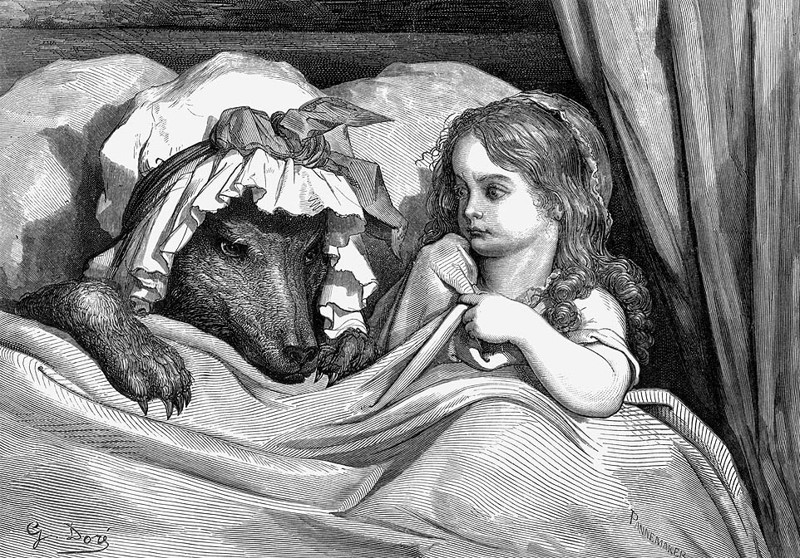
Источник:
История о девочке и голодном волке известна в Европе с XIV века. Содержимое корзинки менялось в зависимости от местности, а вот сама история была гораздо более неудачной для Золушки. Убив бабушку, волк не просто ее съедает, а готовит из ее тела вкусняшку, а из крови — некий напиток. Спрятавшись в кровати, он наблюдает, так Красная Шапочка с аппетитом уплетает свою же бабушку. Предупредить девочку пытается бабушкина кошка, но и она умирает страшной смертью (волк бросает в нее тяжелые деревянные башмаки). Красную Шапочку это, по-видимому, не смущает, и после сытного обеда она послушно раздевается и ложится в кровать, где ее поджидает волк. В большинстве версий на этом все заканчивается — мол, поделом глупой девчонке!
Впоследствии Шарль Перро сочинил для этой истории оптимистичный финал и добавил мораль для всех, кого всякие незнакомцы зазывают к себе в кровать:
Детишкам маленьким не без причин
(А уж особенно девицам,
Красавицам и баловницам),
В пути встречая всяческих мужчин,
Нельзя речей коварных слушать, —
Иначе волк их может скушать.
Сказал я: волк! Волков не счесть,
Но между ними есть иные
Плуты, настолько продувные,
Что, сладко источая лесть,
Девичью охраняют честь,
Сопутствуют до дома их прогулкам,
Проводят их бай-бай по темным закоулкам…
Но волк, увы, чем кажется скромней,
Тем он всегда лукавей и страшней!
Спящая Красавица

Источник:
Современная версия о поцелуе, разбудившем красавицу, — просто детский лепет по сравнению с оригинальным сюжетом, который записал для потомков все тот же Джамбаттиста Базиле. Красавицу из его сказки по имени Талия тоже настигло проклятье в виде укола веретена, после которого принцесса заснула беспробудным сном. Безутешный король-отец оставил в маленьком домике в лесу, но никак не мог предположить, что произойдет дальше. Спустя годы мимо проезжал еще один король, зашел в домик и увидел Спящую Красавицу. Недолго думая, он перенес ее на постель и, так сказать, воспользовался ситуацией, а потом уехал и забыл обо всем на долгое время. А изнасилованная во сне красавица через девять месяцев родила близнецов — сына по имени Солнце и дочку Луну. Именно они разбудили Талию: мальчик в поисках материнской груди принялся сосать ее палец и случайно высосал отравленный шип. Дальше — больше. Похотливый король снова приехал в заброшенный домик и обнаружил там потомство.
Пообещал девушке золотые горы и вновь уехал в свое королевство, где его, между прочим, ждала законная жена. Супруга короля, узнав о разлучнице, решила ее истребить вместе со всем выводком и заодно наказать неверного мужа. Она приказала убить малышей и приготовить из них мясные пироги для короля, а принцессу — сжечь. Уже перед самым огнем крики красавицы услышал король, который прибежал и сжег не ее, а надоевшую злобную королеву. И напоследок хорошая новость: близнецов не съели, потому что повар оказался нормальным человеком и спас детишек, заменив их ягненком.
Защитник девичьей чести Шарль Перро, конечно, сказку сильно изменил, но не удержался от «морали» в конце истории. Его напутствие гласит:
Немножко обождать,
Чтоб подвернулся муж,
Красавец и богач к тому ж,
Вполне возможно и понятно.
Но сотню долгих лет,
В постели лежа, ждать
Для дам настолько неприятно,
Что ни одна не сможет спать…
Русалочка

Источник:
В оригинальном сюжете Ганса Христиана Андерсена русалочка, которая обрела ноги, испытывала мучительную боль при каждом шаге. При этом ей было дано условие: если принц женится на ком-то другом, она умрет и превратится в морскую пену (в итоге принц таки женился на другой). В попытке спасти свою сестру другие русалки заговорили кинжал у морской ведьмы. Заклинание предполагало,что если Русалочка убьёт этим кинжалом принца и капнет его кровью на ноги, то избавится от боли, снова вернувшись в море. Правда, любовь победила и принц остался жив.
Вообще встречаются самые разные версии этих сказок и нет смысла все их сваливать в один пост но хочется добавить что современные сказки куда более адаптированные для нашего времени чем чудовищные сказки Средних веков, доходя и до 19-го века, а то и ближе.
Надеюсь никто не захочет почитать своим детям эти сказки в оригинальном тексте
Источник: