
Петер Кристен Асбьёрнсен
НА ВОСТОК ОТ СОЛНЦА, НА ЗАПАД ОТ ЛУНЫ
Памяти Тамары Григорьевны Габбе, с которой мы вместе начинали работу над пересказом этих преданий и сказок.

Норвежские сказки и предания
Пересказала для детей Александра Иосифовна Любарская
Оформление и рисунки художника Н. И. Брюханова

Вороны Ут-Рёста

Нередко случается, что рыбаки северной Норвегии, вернувшись с промысла домой, находят то прилипшие к рулю хлебные колосья, то ячменные зерна в желудке у выловленной рыбы.
Тогда они знают, что их лодки проходили мимо чудесных островов, о которых поется в старых дедовских песнях. Солнце светит там ярче, чем всюду, луга там зеленее, поля плодороднее, а рыба в море никогда не переводится — сколько ни закидывай сеть, всегда полна.
Но не всем дано увидеть эти острова. Только чистому сердцу и смелому душой в недобрый час, когда яростные волны грозят гибелью, открываются эти таинственные земли. И счастлив тот, кто ступит на их приветливые, солнечные берега, — он спасен. Предание рассказывает, что в море есть три таких острова. Один остров называется Сандфлес. Он поднимается из морской глубины недалеко от Гельголанда, и берега его изобилуют рыбой и дичью.
У другого острова нет названия. Словно нехотя показывается он в водах Вестфьёрда. Его ровная поверхность так и остается под водой, и только тяжёлые налитые колосья колышутся над свинцовыми волнами.
Третий остров — самый большой — появляется недалеко от Рёста, южнее Лофотенских островов, и называется он Ут-Рёст.
Жители этой благодатной земли не знают нужды.
По зелёным обширным пастбищам Ут-Рёста ходят тучные стада, поля золотятся ячменными колосьями, у причалов стоят суда с рыболовными снастями, всегда готовые выйти в плаванье.
Старые рыбаки рассказывают, что им случалось видеть в море неведомые корабли, которые неслись им навстречу под всеми парусами.
Кажется, вот-вот корабль врежется в рыбачий баркас… Но в самую последнюю минуту корабль вдруг исчезал, словно облако, развеянное ветром.
— Это Ут-Рёст вышел на лов, — говорили тогда рыбаки.
Много лет тому назад жил недалеко от Рёста бедный рыбак, по имени Маттиас.
Детей у него был полон дом, а добра всего-навсего — лодка и две козы. Лодка была старая, не раз чиненная, а козы тощие и облезлые, потому что кормились они рыбьими хвостами да жалкой травкой, которую им удавалось найти на прибрежных скалах.
Трудно жилось Маттиасу. Дети его частенько бегали голодные. Но он был не из тех, кто жалуется на судьбу и вешает голову, склоняясь перед неудачей.
— Ничего, нынче ветер встречный, завтра будет попутный, — любил приговаривать Маттиас, когда ему не везло. А не везло ему часто, — гораздо чаще, чем везло.
И вот однажды вышел Маттиас в море на рыбную ловлю. Давно уже не было у него такого хорошего улова, как в этот раз.
Одну за другой вытаскивал он тяжёлые сети.
Лодка его чуть ли не до половины была полна рыбой, и он уже радовался, подсчитывая, сколько муки и сала купит на деньги, вырученные от продажи рыбы.
Он был так занят своим делом, что не заметил, как чёрная туча затянула небо. Вдруг стемнело, налетел ураган и поднялась такая буря, какой Маттиас не видывал отроду.
Отяжелевшую от груза лодку так и бросало из стороны в сторону. В конце концов бедняге пришлось выбросить за борт весь улов, чтобы не пойти ко дну вместе со своим богатством… И всё-таки ему было нелегко удержаться на расходившейся волне.
Но недаром Маттиас прожил всю свою жизнь на море.
Много часов боролся он с бурей, ловко поворачивая лодку всякий раз, когда тяжёлые валы обрушивались на неё и морская пучина готова была её поглотить.
Время шло, а буря не утихала и туман сгущался всё больше и больше. В какую сторону ни всматривался Маттиас, земли нигде не было видно. То ли его закружила буря, то ли ветер переменился, только он понял, что его несёт в открытое море.
Он плыл и плыл, а куда — и сам не знал.
И вдруг среди грохота волн и воя ветра, где-то перед носом лодки, раздался хриплый крик ворона.
Сердце у Маттиаса сжалось.
«Это, верно, морской дух поёт мне погребальную песню, — подумал рыбак. — Видно, пришёл мой последний час…»
В мыслях своих он стал прощаться с женой и детьми и готовиться к смерти.
А карканье послышалось уже совсем рядом.
Маттиас поднял голову. Перед самым бортом мелькнуло что-то чёрное, и он увидел на обломках мачты трёх огромных воронов.
Но в это время сильная волна подхватила его лодку и понесла дальше.
Скоро Маттиас уже не мог бороться с бурей. Ослабевшие руки не справлялись с рулем. От голода и жажды он совсем обессилел. И кончилось тем, что он закрыл глаза и заснул, опустив голову на руль…
Очнулся Маттиас оттого, что ему почудилось, будто лодка его коснулась берега и тихо покачивается на месте.
Он вздрогнул и поднял голову.
Тучи разошлись. Сквозь разрывы облаков проглядывало солнце и своими яркими лучами освещало прекрасную землю. Склоны холмов, покрытые бархатными лугами и золотыми нивами, спускались к самому берегу, а горы до самых вершин были одеты в зелёный лесной наряд.
Воздух был словно пропитан душистым запахом травы и цветов, и Маттиас вдыхал его всей грудью, точно это был сладкий живительный напиток.
«Теперь я спасен, — подумал Маттиас. — Это Ут-Рёст!»

Он вытащил лодку на песок и пошёл по тропинке, которая едва заметной ниточкой тянулась через ячменное поле. С удивлением смотрел Маттиас по сторонам — никогда в жизни не видел он таких тяжёлых, налитых колосьев.
Тропинка привела его к низенькой землянке, покрытой свежим дёрном. На её зеленой крыше паслась белая коза с золотыми рогами и шёлковой шерстью. А перед землянкой на почерневшей колоде сидел маленький старичок в голубом кафтане и курил трубку. Борода у него была такая большая, что свешивалась чуть не до самых колен.

— Добро пожаловать, Маттиас, к нам на Ут-Рёст, — сказал старичок.
— Пусть счастье никогда не покинет эту землю, отец, — сказал Маттиас. — Но разве ты меня знаешь?
— А как же мне тебя не знать? Конечно, знаю, — сказал старичок. — Может, погостишь у нас?
— С радостью, отец, — ответил Маттиас.
— И мы хорошему человеку всегда рады, — сказал старичок. — Скоро и сыновья мои вернутся. Да ты не видел ли их в море?
— Нет, отец, никого я в море не видел, кроме трех воронов.
— Да ведь это мои сыновья и были, — сказал, посмеиваясь, старик. Он выколотил свою трубочку и встал. — Ну, входи, входи, добрый человек. Небось проголодался, пить-есть хочешь. — И он открыл перед Маттиасом дверь своей землянки.
Маттиас переступил порог да так и застыл на месте от удивления. В жизни своей не видел он сразу столько всякой еды. Стол так и ломился под тяжестью мисок, плошек, горшков, кувшинов. И чего только в них не было! И жареное, и варёное, и солёное, и копчёное, и творог, и сметана, и сыр, и паштет, и целая гора бергенских баранок, и пиво, и мёд…
Маттиас ел-пил сколько вздумается, и все равно тарелка перед ним была будто нетронутая, а стакан — полным.
Сам старичок-хозяин ел немного, говорил и того меньше и всё на дверь поглядывал.
Вдруг снаружи зашумели, захлопали сильные крылья и послышалось хриплое карканье.
Дверь с шумом отворилась, и в горницу вошли три рослых плечистых парня — один выше другого.
| East of the Sun and West of the Moon | |
|---|---|

By candlelight, the heroine discovers the identity of her sleeping husband. |
|
| Folk tale | |
| Name | East of the Sun and West of the Moon |
| Also known as | Østenfor sol og vestenfor måne |
| Aarne–Thompson grouping | ATU 425A (The Search for the Lost Husband) |
| Region | Norway |
| Published in | Norske folkeeventyr, by Peter Christen Asbjørnsen and Jørgen Moe |
| Related | Cupid and Psyche; Beauty and the Beast |
«East of the Sun and West of the Moon» (Norwegian: Østenfor sol og vestenfor måne) is a Norwegian fairy tale. It was included by Andrew Lang in The Blue Fairy Book (1890).[1]
«East of the Sun and West of the Moon» was collected by Peter Christen Asbjørnsen and Jørgen Moe. It is Aarne–Thompson type 425A, the search for the lost husband; other tales of this type include «Black Bull of Norroway», «The Brown Bear of Norway», «The Daughter of the Skies», «The Enchanted Pig», «The Tale of the Hoodie», «Master Semolina», «The Sprig of Rosemary», «The Enchanted Snake», and «White-Bear-King-Valemon».[2] The Swedish version is called «Prince Hat under the Ground». It was likely an offspring from the tale of «Cupid and Psyche» in The Golden Ass,[3] which gave rise to similar animal bridegroom cycles[4] such as «Beauty and the Beast».[5]
Synopsis[edit]
The White Bear approaches a poor peasant and asks if he will give him his prettiest and youngest daughter; in return, the bear will make the man rich. The girl is reluctant, so the peasant asks the bear to return, and in the meantime, persuades her to marry the bear. The White Bear takes her off to a magnificent enchanted castle. At night, he discards his bear form, and comes to her bed as a man. She never sees him, however, because he enters her bedroom after she extinguishes the light, and leaves before daybreak.

The white bear carries his intended on his back. Illustration from The Blue Fairy Book by Henry Justice Ford.
When she grows homesick, the bear agrees that she might go home as long as she agrees that she will never speak with her mother alone, but only when other people are around. At home, her family welcomes her, and her mother makes persistent attempts to speak with her alone. She finally persuades her daughter to disclose the entire account about the stranger man who sleeps beside her in the dark each night, and leaves before daybreak. In response to the girl’s story, she insists that the White Bear must really be a troll, gives her a candle, and tells her to light it at night, to see who is sharing her bed, warning her not to spill any tallow.

The princess holds up the lamp to take a glimpse at the mysterious prince. Illustration by John Batten for Joseph Jacobs’s Europa’s Fairy Book (1916).
The girl obeys, and discovers that the bear is actually an attractive prince. Falling in love with him at first sight, she kisses him, and spills three drops of tallow on him. Waking him, thus, she is told that if she had waited for a year, he would have been free, but now he must go to his wicked stepmother, a witch-queen who turned him into his form and lives in a castle that lies «east of the Sun and west of the Moon», and marry her daughter, a witch-princess.
In the morning, the girl finds that the palace has vanished. She sets out in search of the prince. Coming to a great mountain, she finds an old woman playing with a golden apple. She asks the old woman if she knows the way to the castle that lies east of the Sun and west of the Moon. The old woman cannot tell her the way, but lends her a horse to ride to a neighbor who might be able to, and gives her the apple. The neighbor is sitting outside another mountain, with a golden carding comb. She, also, does not know the way to the castle, but lends the girl another horse to ride to another neighbor who might know, and gives her the carding comb. That third old woman does not know the way to the castle either, but lends the girl another horse to ride to the East Wind, and gives her the golden spinning wheel with which she had been working.
The East Wind has never been to the castle that lies east of the Sun and west of the Moon, but believes his stronger brother, the West Wind might have been there. He takes her to the West Wind, who brings her to the South Wind for the same reason. The South Wind brings her to the North Wind, again, for the same reason. The North Wind says he once exhausted himself blowing an aspen leaf to her desired destination, but would take her there if she was absolutely determined to go there. The girl says she is determined to go there, and so, he takes her there.
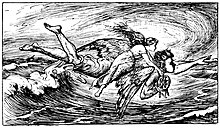
The North Wind carries the maiden across the stormy sea. Illustration from The Blue Fairy Book by Henry Justice Ford.
The morning after her arrival at the queen’s castle, the girl starts to play with the golden apple. The queen’s daughter, who is betrothed to the prince, sees the golden plaything, and says to the girl that she would like to buy it. The girl agrees to part with it in exchange for a night with the prince. The princess agrees to the exchange, but gives the prince a sleeping drink, so that he cannot be woken up. These events recur the next night, after the girl gives the princess the gold carding comb. This time, the girl’s weeping and plaintive utterances, as she attempts to awaken the prince, are overheard by imprisoned townspeople within the castle. They report to him what they had overheard. On the third day, the princess agrees to another night in the prince’s bedchamber in exchange for the girl’s golden spinning wheel. That night, the prince does not drink the potion that the princess brings him, and so, he is awake for the girl’s visit.
The prince tells her how she can save him: He will declare that he will marry anyone who can wash out the tallow stains from his shirt, since his stepmother and her daughter cannot do it. He would call on the girl for this purpose. When she succeeds, he would claim her for his bride. The plan works out, and rage causes the two witches to explode. The spell is broken, and the prince no longer needs to assume his bear form during the day. He and his bride free the prisoners within the castle, and leave it far behind them with all the gold and silver that had been housed within it.
Variants[edit]
Finnish folklorist Oskar Hackman summarized a Finnish-Swedish tale from Vörå. In this tale, a large-nosed woman wants to marry a handsome man, but he rebuffs her. The woman, then, curses him to become a bear. The bear wanders to the forest and finds a hut, where a man lives with his daughter. The animal asks for the man’s daughter, in exchange for getting some financial benefits. The bear and the girl live like husband and wife, but he becomes a man at night, and disappears during the day, and she cannot light any candle at home. Eventually, the girl goes back to her father’s home and returns with some candles. She lights a candle and sees her bear husband is, in fact, a handsome man. A drop of tallow falls in his shirt, he wakes up and says they must depart. The girl is given a gold spinning wheel and is sent back to her father’s hut. The girl decides to go after him and finds him at the house of the large-nosed woman. She tries to sell the spinning wheel for a night with the bear (in human form), but cannot wake him up. On the third night, the girl sells it to the large-nosed woman and wakes him up. The girl and the man decide to play a trick on the large-nosed woman: he will set a challenge for his future bride to wash the tallow spot on his shirt. The large-nosed woman and her maidservants fail, but the girl washes the shirt. For her failure, the large-nosed woman bursts, and the man marries the girl.[6]
Analysis[edit]
In folktales classified as tale type ATU 425A, «The Search for the Lost Husband» or «The Animal as Bridegroom», the maiden breaks a taboo or burns the husband’s animal skin and, to atone, she must wear down a numbered pair of metal shoes. On her way to her husband, she asks for the help of the Sun, the Moon and the Wind.[7][8] According to Hans-Jörg Uther, the main feature of tale type ATU 425A is «bribing the false bride for three nights with the husband».[9][a] Østenfor sol og vestenfor måne is also the name given to tale type ATU 425 («The Search for the Lost Husband») in Ørnulf Hodne [no]‘s The Types of the Norwegian Folktale.[11]
Retellings and translations into English[edit]
- Eastward of the Sun, and Westward of the Moon, 1849, by Anthony R. Montalba, in Fairy Tales From all Nations. London: Chapman and Hall, 1849.
- The Mysterious Prince, 1908, by Wilbur Herschel Williams, in Fairy Tales From Folk Lore. New York: Moffat, Yard & Company, 1908.
- East o’ the Sun & West o’ the Moon, 1910, translated by Sir George Webbe Dasent and illustrated by the brothers Reginald L. Knowles and Horace J. Knowles.
- East o’ the Sun & West o’ the Moon, translated by G. W. Dasent (1910), illustrated by P. J. Lynch.
- East of the Sun & West of the Moon, 1914, translated by G. W. Dasent (1910), illustrated by Kay Nielsen.
- «East of the Sun and West of the Moon», The Dancing Bears, 1954, by W. S. Merwin
- East of the Sun and West of the Moon retold by Kathleen and Michael Hague and illustrated by Michael Hague (Harcourt Brace Jovanovich, 1980) ISBN 0-15-224703-3.
- East of the Sun & West of the Moon, 1980, written and illustrated by Mercer Mayer
- East of the Sun, West of the Moon, by D. J. MacHale, illustrated by Vivienne Flesher (Rabbit Ears Productions).
- East of the Sun & West of the Moon, 1994, play by Tina Howe.
- East of the Sun, West of the Moon. Adapted by Anthony Ravenhall for the stage:[12] Cleveland Theatre Company (CTC) in 1994. Directed by Anthony Ravenhall, toured Christmas 1994/5. Also toured 1996/97 Northumberland Theatre Company (NTC).
- East of the Sun, a short play by Darcy Parker Bruce, included in «The Best American Short Plays 2015-2016» edited by William Demastes and John Patrick Bray.
- Once Upon a Winter’s Night, 2001, by Dennis L. McKiernan
- East, 2003, novel by Edith Pattou.
- Sun and Moon, Ice and Snow, 2009, by Jessica Day George
- Ice, 2009, novel by Sarah Beth Durst.
- Enchanted: East of the sun, West of the moon, by Nancy Madore.
- East of the Sun, West of the Moon, 2013, written and illustrated by Jackie Morris.
- A Court of Thorns and Roses, 2015, by Sarah J. Maas.
- Echo North, 2019, novel by Joanna Ruth Meyer.
- Beautiful, 2019, audiobook by Juliet Marillier.
Film adaptations[edit]
- In the early 1980s, Don Bluth Productions began work on an animated feature film entitled East of the Sun and West of the Moon.[13][14] Ultimately, the film was never made due to a loss of financial backing,[15] even though the film was heavily into production at the time of its cancellation.
- Max von Sydow narrates the Rabbit Ears Productions’ version of «East of the Sun and West of the Moon» to musical accompaniment by Lyle Mays.
- The Storyteller features the episode «The True Bride», which was directly based on a German folktale of the same name, but references this story in its ending. The heroine’s love is bewitched by a female troll into forgetting her, but the prince is told the truth by the troll’s prisoners. In the episode «Hans My Hedgehog» the husband also turns from a beast into a human.
- The themes of «East of the Sun and West of the Moon» appear in the 1991 film The Polar Bear King,[16] also known as Kvitebjørn Kong Valemon. The story of the film is almost an exact parallel to the fairy tale.[17]
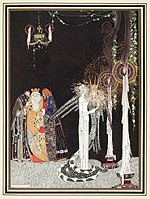
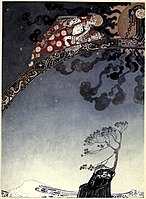
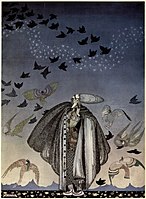
Illustrations by Kay Nielsen (1914)[edit]








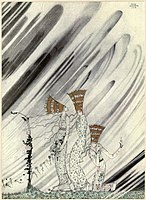
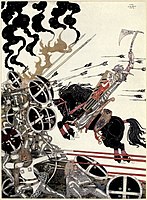

See also[edit]
- Cupid and Psyche – Classical story of Cupid and Psyche
- Eglė the Queen of Serpents – Lithuanian folktale
- Pintosmalto – 1634 Italian literary fairy tale by Giambattista Basile
- The Feather of Finist the Falcon – Russian fairy tale
- J. R. R. Tolkien’s use of this phrase – Walking songs from The Lord of the Rings
- Sigurd, the King’s Son (Icelandic fairy tale)
- The Singing, Springing Lark – German fairy tale
- The Three Daughters of King O’Hara – Irish fairy tale
- The Three Princesses of Whiteland – Norwegian fairy tale
- The Two Kings’ Children – German fairy tale
- Tulisa, the Wood-Cutter’s Daughter (Indian folktale)
Footnotes[edit]
- ^ A similar assessment was made by scholar Andreas John: «The episode of ‘buying three nights’ in order to recover a spouse is more commonly developed in tales about female heroines who search for their husbands (AT 425, 430, and 432) …»[10]
References[edit]
- ^ Andrew Lang, The Blue Fairy Book, «East of the Sun and West of the Moon»
- ^ Heidi Anne Heiner, East of the Sun and West of the Moon: Related Tales
- ^ Neumann, Erich. Amor and Psyche: The psychic development of the feminine. Vol. 24. Routledge, 2013.
- ^ Leavy, Barbara Fass. «The Animal Groom.» In Search of the Swan Maiden. New York University Press, 1995. 101-155.
- ^ Hood, Gwyneth. «Husbands and Gods as Shadowbrutes: Beauty and the Beast from Apuleius to CS Lewis.» Mythlore 15.2 (56 (1988): 33-60.
- ^ Hackman, O. «Finlands svenska folkdiktning». Skrifter / utgivna av Svenska litteratursällskapet i Finland. Helsingfors. 1917. p. 152 (entry 70.3); 520 (classification).
- ^ Thompson, Stith (1977). The Folktale. University of California Press. pp. 97-98. ISBN 0-520-03537-2
- ^ Ursache, Otilia. «Chipul tăinuit în basmele populare europene». In: Philologica Jassyensia, XI (1). 2015. pp. 269, 271-273. ISSN 2247-8353
- ^ Hurbánková, Šárka. (2018). «G. B. Basile and Apuleius: First literary tales. morphological analysis of three fairytales». In: Graeco-Latina Brunensia. 23: 81 (footnote nr. 37). 10.5817/GLB2018-2-6.
- ^ Johns, Andreas. Baba Yaga: The Ambiguous Mother and Witch of the Russian Folktale. New York: Peter Lang. 2010 [2004]. p. 148. ISBN 978-0-8204-6769-6
- ^ Hodne, Ørnulf. The Types of the Norwegian Folktale. Universitetsforlaget, 1984. p. 97.
- ^ TES 27/12/1996
- ^ John Grant, p. 35, Masters of Animation, ISBN 0-8230-3041-5
- ^ John Culhane, «Special Effects Are Revolutionizing Film»
- ^ «Newswatch: Bluth animation film goes bankrupt», The Comics Journal #98 (May 1985), p. 19.
- ^ anatisfairywheel (28 November 1991). «Kvitebjørn Kong Valemon (1991)». IMDb.
- ^ Heiner, Heidi Anne (2020-08-13). «SurLaLune Fairy Tales: Modern Interpretations of East of the Sun and West of the Moon». surlalunefairytales.com. Retrieved 2020-08-13.
External links[edit]

Wikisource has original text related to this article:

- SurLaLune Fairy Tales, annotated version of East of the Sun and West of the Moon
- East of the Sun and West of the Moon in full length
- Asbjørnsen, Peter Christen; Moe, Jørgen (1899). «41 Østenfor Sol og vestenfor Manne». Norske folke-eventyr. Vol. 2. Kristiania: Aschehoug.
 East of the Sun and West of the Moon public domain audiobook at LibriVox
 East of the Sun and West of the Moon public domain audiobook at LibriVox
| East of the Sun and West of the Moon | |
|---|---|
|
By candlelight, the heroine discovers the identity of her sleeping husband. |
|
| Folk tale | |
| Name | East of the Sun and West of the Moon |
| Also known as | Østenfor sol og vestenfor måne |
| Aarne–Thompson grouping | ATU 425A (The Search for the Lost Husband) |
| Region | Norway |
| Published in | Norske folkeeventyr, by Peter Christen Asbjørnsen and Jørgen Moe |
| Related | Cupid and Psyche; Beauty and the Beast |
«East of the Sun and West of the Moon» (Norwegian: Østenfor sol og vestenfor måne) is a Norwegian fairy tale. It was included by Andrew Lang in The Blue Fairy Book (1890).[1]
«East of the Sun and West of the Moon» was collected by Peter Christen Asbjørnsen and Jørgen Moe. It is Aarne–Thompson type 425A, the search for the lost husband; other tales of this type include «Black Bull of Norroway», «The Brown Bear of Norway», «The Daughter of the Skies», «The Enchanted Pig», «The Tale of the Hoodie», «Master Semolina», «The Sprig of Rosemary», «The Enchanted Snake», and «White-Bear-King-Valemon».[2] The Swedish version is called «Prince Hat under the Ground». It was likely an offspring from the tale of «Cupid and Psyche» in The Golden Ass,[3] which gave rise to similar animal bridegroom cycles[4] such as «Beauty and the Beast».[5]
Synopsis[edit]
The White Bear approaches a poor peasant and asks if he will give him his prettiest and youngest daughter; in return, the bear will make the man rich. The girl is reluctant, so the peasant asks the bear to return, and in the meantime, persuades her to marry the bear. The White Bear takes her off to a magnificent enchanted castle. At night, he discards his bear form, and comes to her bed as a man. She never sees him, however, because he enters her bedroom after she extinguishes the light, and leaves before daybreak.
The white bear carries his intended on his back. Illustration from The Blue Fairy Book by Henry Justice Ford.
When she grows homesick, the bear agrees that she might go home as long as she agrees that she will never speak with her mother alone, but only when other people are around. At home, her family welcomes her, and her mother makes persistent attempts to speak with her alone. She finally persuades her daughter to disclose the entire account about the stranger man who sleeps beside her in the dark each night, and leaves before daybreak. In response to the girl’s story, she insists that the White Bear must really be a troll, gives her a candle, and tells her to light it at night, to see who is sharing her bed, warning her not to spill any tallow.
The princess holds up the lamp to take a glimpse at the mysterious prince. Illustration by John Batten for Joseph Jacobs’s Europa’s Fairy Book (1916).
The girl obeys, and discovers that the bear is actually an attractive prince. Falling in love with him at first sight, she kisses him, and spills three drops of tallow on him. Waking him, thus, she is told that if she had waited for a year, he would have been free, but now he must go to his wicked stepmother, a witch-queen who turned him into his form and lives in a castle that lies «east of the Sun and west of the Moon», and marry her daughter, a witch-princess.
In the morning, the girl finds that the palace has vanished. She sets out in search of the prince. Coming to a great mountain, she finds an old woman playing with a golden apple. She asks the old woman if she knows the way to the castle that lies east of the Sun and west of the Moon. The old woman cannot tell her the way, but lends her a horse to ride to a neighbor who might be able to, and gives her the apple. The neighbor is sitting outside another mountain, with a golden carding comb. She, also, does not know the way to the castle, but lends the girl another horse to ride to another neighbor who might know, and gives her the carding comb. That third old woman does not know the way to the castle either, but lends the girl another horse to ride to the East Wind, and gives her the golden spinning wheel with which she had been working.
The East Wind has never been to the castle that lies east of the Sun and west of the Moon, but believes his stronger brother, the West Wind might have been there. He takes her to the West Wind, who brings her to the South Wind for the same reason. The South Wind brings her to the North Wind, again, for the same reason. The North Wind says he once exhausted himself blowing an aspen leaf to her desired destination, but would take her there if she was absolutely determined to go there. The girl says she is determined to go there, and so, he takes her there.
The North Wind carries the maiden across the stormy sea. Illustration from The Blue Fairy Book by Henry Justice Ford.
The morning after her arrival at the queen’s castle, the girl starts to play with the golden apple. The queen’s daughter, who is betrothed to the prince, sees the golden plaything, and says to the girl that she would like to buy it. The girl agrees to part with it in exchange for a night with the prince. The princess agrees to the exchange, but gives the prince a sleeping drink, so that he cannot be woken up. These events recur the next night, after the girl gives the princess the gold carding comb. This time, the girl’s weeping and plaintive utterances, as she attempts to awaken the prince, are overheard by imprisoned townspeople within the castle. They report to him what they had overheard. On the third day, the princess agrees to another night in the prince’s bedchamber in exchange for the girl’s golden spinning wheel. That night, the prince does not drink the potion that the princess brings him, and so, he is awake for the girl’s visit.
The prince tells her how she can save him: He will declare that he will marry anyone who can wash out the tallow stains from his shirt, since his stepmother and her daughter cannot do it. He would call on the girl for this purpose. When she succeeds, he would claim her for his bride. The plan works out, and rage causes the two witches to explode. The spell is broken, and the prince no longer needs to assume his bear form during the day. He and his bride free the prisoners within the castle, and leave it far behind them with all the gold and silver that had been housed within it.
Variants[edit]
Finnish folklorist Oskar Hackman summarized a Finnish-Swedish tale from Vörå. In this tale, a large-nosed woman wants to marry a handsome man, but he rebuffs her. The woman, then, curses him to become a bear. The bear wanders to the forest and finds a hut, where a man lives with his daughter. The animal asks for the man’s daughter, in exchange for getting some financial benefits. The bear and the girl live like husband and wife, but he becomes a man at night, and disappears during the day, and she cannot light any candle at home. Eventually, the girl goes back to her father’s home and returns with some candles. She lights a candle and sees her bear husband is, in fact, a handsome man. A drop of tallow falls in his shirt, he wakes up and says they must depart. The girl is given a gold spinning wheel and is sent back to her father’s hut. The girl decides to go after him and finds him at the house of the large-nosed woman. She tries to sell the spinning wheel for a night with the bear (in human form), but cannot wake him up. On the third night, the girl sells it to the large-nosed woman and wakes him up. The girl and the man decide to play a trick on the large-nosed woman: he will set a challenge for his future bride to wash the tallow spot on his shirt. The large-nosed woman and her maidservants fail, but the girl washes the shirt. For her failure, the large-nosed woman bursts, and the man marries the girl.[6]
Analysis[edit]
In folktales classified as tale type ATU 425A, «The Search for the Lost Husband» or «The Animal as Bridegroom», the maiden breaks a taboo or burns the husband’s animal skin and, to atone, she must wear down a numbered pair of metal shoes. On her way to her husband, she asks for the help of the Sun, the Moon and the Wind.[7][8] According to Hans-Jörg Uther, the main feature of tale type ATU 425A is «bribing the false bride for three nights with the husband».[9][a] Østenfor sol og vestenfor måne is also the name given to tale type ATU 425 («The Search for the Lost Husband») in Ørnulf Hodne [no]‘s The Types of the Norwegian Folktale.[11]
Retellings and translations into English[edit]
- Eastward of the Sun, and Westward of the Moon, 1849, by Anthony R. Montalba, in Fairy Tales From all Nations. London: Chapman and Hall, 1849.
- The Mysterious Prince, 1908, by Wilbur Herschel Williams, in Fairy Tales From Folk Lore. New York: Moffat, Yard & Company, 1908.
- East o’ the Sun & West o’ the Moon, 1910, translated by Sir George Webbe Dasent and illustrated by the brothers Reginald L. Knowles and Horace J. Knowles.
- East o’ the Sun & West o’ the Moon, translated by G. W. Dasent (1910), illustrated by P. J. Lynch.
- East of the Sun & West of the Moon, 1914, translated by G. W. Dasent (1910), illustrated by Kay Nielsen.
- «East of the Sun and West of the Moon», The Dancing Bears, 1954, by W. S. Merwin
- East of the Sun and West of the Moon retold by Kathleen and Michael Hague and illustrated by Michael Hague (Harcourt Brace Jovanovich, 1980) ISBN 0-15-224703-3.
- East of the Sun & West of the Moon, 1980, written and illustrated by Mercer Mayer
- East of the Sun, West of the Moon, by D. J. MacHale, illustrated by Vivienne Flesher (Rabbit Ears Productions).
- East of the Sun & West of the Moon, 1994, play by Tina Howe.
- East of the Sun, West of the Moon. Adapted by Anthony Ravenhall for the stage:[12] Cleveland Theatre Company (CTC) in 1994. Directed by Anthony Ravenhall, toured Christmas 1994/5. Also toured 1996/97 Northumberland Theatre Company (NTC).
- East of the Sun, a short play by Darcy Parker Bruce, included in «The Best American Short Plays 2015-2016» edited by William Demastes and John Patrick Bray.
- Once Upon a Winter’s Night, 2001, by Dennis L. McKiernan
- East, 2003, novel by Edith Pattou.
- Sun and Moon, Ice and Snow, 2009, by Jessica Day George
- Ice, 2009, novel by Sarah Beth Durst.
- Enchanted: East of the sun, West of the moon, by Nancy Madore.
- East of the Sun, West of the Moon, 2013, written and illustrated by Jackie Morris.
- A Court of Thorns and Roses, 2015, by Sarah J. Maas.
- Echo North, 2019, novel by Joanna Ruth Meyer.
- Beautiful, 2019, audiobook by Juliet Marillier.
Film adaptations[edit]
- In the early 1980s, Don Bluth Productions began work on an animated feature film entitled East of the Sun and West of the Moon.[13][14] Ultimately, the film was never made due to a loss of financial backing,[15] even though the film was heavily into production at the time of its cancellation.
- Max von Sydow narrates the Rabbit Ears Productions’ version of «East of the Sun and West of the Moon» to musical accompaniment by Lyle Mays.
- The Storyteller features the episode «The True Bride», which was directly based on a German folktale of the same name, but references this story in its ending. The heroine’s love is bewitched by a female troll into forgetting her, but the prince is told the truth by the troll’s prisoners. In the episode «Hans My Hedgehog» the husband also turns from a beast into a human.
- The themes of «East of the Sun and West of the Moon» appear in the 1991 film The Polar Bear King,[16] also known as Kvitebjørn Kong Valemon. The story of the film is almost an exact parallel to the fairy tale.[17]
Illustrations by Kay Nielsen (1914)[edit]
See also[edit]
- Cupid and Psyche – Classical story of Cupid and Psyche
- Eglė the Queen of Serpents – Lithuanian folktale
- Pintosmalto – 1634 Italian literary fairy tale by Giambattista Basile
- The Feather of Finist the Falcon – Russian fairy tale
- J. R. R. Tolkien’s use of this phrase – Walking songs from The Lord of the Rings
- Sigurd, the King’s Son (Icelandic fairy tale)
- The Singing, Springing Lark – German fairy tale
- The Three Daughters of King O’Hara – Irish fairy tale
- The Three Princesses of Whiteland – Norwegian fairy tale
- The Two Kings’ Children – German fairy tale
- Tulisa, the Wood-Cutter’s Daughter (Indian folktale)
Footnotes[edit]
- ^ A similar assessment was made by scholar Andreas John: «The episode of ‘buying three nights’ in order to recover a spouse is more commonly developed in tales about female heroines who search for their husbands (AT 425, 430, and 432) …»[10]
References[edit]
- ^ Andrew Lang, The Blue Fairy Book, «East of the Sun and West of the Moon»
- ^ Heidi Anne Heiner, East of the Sun and West of the Moon: Related Tales
- ^ Neumann, Erich. Amor and Psyche: The psychic development of the feminine. Vol. 24. Routledge, 2013.
- ^ Leavy, Barbara Fass. «The Animal Groom.» In Search of the Swan Maiden. New York University Press, 1995. 101-155.
- ^ Hood, Gwyneth. «Husbands and Gods as Shadowbrutes: Beauty and the Beast from Apuleius to CS Lewis.» Mythlore 15.2 (56 (1988): 33-60.
- ^ Hackman, O. «Finlands svenska folkdiktning». Skrifter / utgivna av Svenska litteratursällskapet i Finland. Helsingfors. 1917. p. 152 (entry 70.3); 520 (classification).
- ^ Thompson, Stith (1977). The Folktale. University of California Press. pp. 97-98. ISBN 0-520-03537-2
- ^ Ursache, Otilia. «Chipul tăinuit în basmele populare europene». In: Philologica Jassyensia, XI (1). 2015. pp. 269, 271-273. ISSN 2247-8353
- ^ Hurbánková, Šárka. (2018). «G. B. Basile and Apuleius: First literary tales. morphological analysis of three fairytales». In: Graeco-Latina Brunensia. 23: 81 (footnote nr. 37). 10.5817/GLB2018-2-6.
- ^ Johns, Andreas. Baba Yaga: The Ambiguous Mother and Witch of the Russian Folktale. New York: Peter Lang. 2010 [2004]. p. 148. ISBN 978-0-8204-6769-6
- ^ Hodne, Ørnulf. The Types of the Norwegian Folktale. Universitetsforlaget, 1984. p. 97.
- ^ TES 27/12/1996
- ^ John Grant, p. 35, Masters of Animation, ISBN 0-8230-3041-5
- ^ John Culhane, «Special Effects Are Revolutionizing Film»
- ^ «Newswatch: Bluth animation film goes bankrupt», The Comics Journal #98 (May 1985), p. 19.
- ^ anatisfairywheel (28 November 1991). «Kvitebjørn Kong Valemon (1991)». IMDb.
- ^ Heiner, Heidi Anne (2020-08-13). «SurLaLune Fairy Tales: Modern Interpretations of East of the Sun and West of the Moon». surlalunefairytales.com. Retrieved 2020-08-13.
External links[edit]
Wikisource has original text related to this article:
- SurLaLune Fairy Tales, annotated version of East of the Sun and West of the Moon
- East of the Sun and West of the Moon in full length
- Asbjørnsen, Peter Christen; Moe, Jørgen (1899). «41 Østenfor Sol og vestenfor Manne». Norske folke-eventyr. Vol. 2. Kristiania: Aschehoug.
- East of the Sun and West of the Moon public domain audiobook at LibriVox